Learn what every symbol on the card means.Full credits and sources at beakbrain.com/symbols
 RiverineCavity nestSmall · 31 g


ID tip
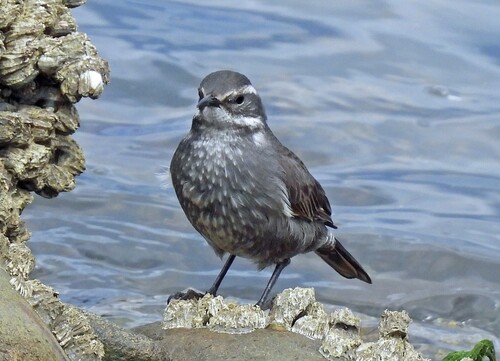
The dark-bellied cinclodes is 18 to 20 cm (7.1 to 7.9 in) long and weighs about 36 to 50 g (1.3 to 1.8 oz). It is a largish cinclodes with a long decurved bill. The sexes have the same plumages, and the two subspecies differ very little. Adults of the nominate subspecies have a white supercilium that begins at the forehead, dark brown lores and ear coverts, and a white malar area with some faint darker flecks. Their crown and nape are dark brown and their upperparts a slightly lighter brown. Their wings are dark brown with blackish brown primary coverts. Voice: The dark-bellied cinclodes is very vocal during the breeding season. Its song is "a piercing weep weep weep tirrrrRRRrr", sung during the male's display and sometimes in a duet by the pair. Its call is a "short, sharp, and stuttering disyllabic ch'tp lasting from 2 to several (>15) notes".
Text from Wikipedia, licensed CC BY-SA 4.0.
When to see the Dark-bellied Cinclodes
One bar for each month, and every month is filled: this bird is recorded here in all twelve. The wide bar is January, the month with the most records.
Where to see the Dark-bellied Cinclodes
The map shades 2 countries with regular records. Everything unshaded has no records. Countries are listed below the map.
About the Dark-bellied Cinclodes
The dark-bellied cinclodes is a species of bird in the Furnariinae subfamily of the ovenbird family Furnariidae. It is found in Argentina and Chile.
Text adapted from Wikipedia, licensed CC BY-SA 4.0.
Easily confused with
 Buff-winged CinclodesCinclodes fuscusThe buff-winged cinclodes is 15 to 19.4 cm (5.9 to 7.6 in) long and weighs 29 to 33 g (1.0 to 1.2 oz).
 Grey-flanked CinclodesCinclodes oustaletiThe grey-flanked cinclodes is 17 to 18 cm (6.7 to 7.1 in) long and weighs 22 to 31 g (0.78 to 1.1 oz).
 Chestnut-winged CinclodesCinclodes albidiventrisThe chestnut-winged cinclodes is a species of bird in the family Furnariidae.
Side by side: Buff-winged Cinclodes vs Dark-bellied Cinclodes · Dark-bellied Cinclodes vs Grey-flanked Cinclodes
Learn the Dark-bellied Cinclodes in the BeakBrain App
Photo and call practice. Coming soon to iPhone and Android.
Play today's Daily BirdEvery photo and recording on this page is credited to its author under the licence shown. Spotted a problem with this page, or have a better photo? Contribute.