Learn what every symbol on the card means.Full credits and sources at beakbrain.com/symbols
 ForestCup nestLarge · 433 g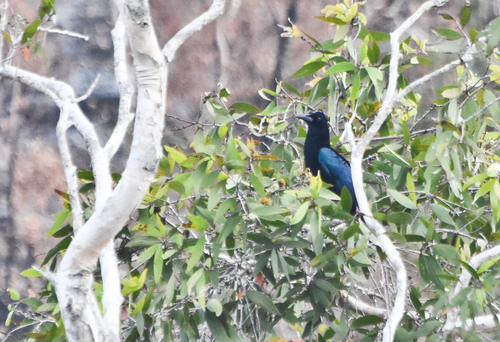


ID tip
Manucodia comrii has a compact and large body approximately 43 cm long, with glossy purple, black and green plumage, red iris and crinkled yellowish-green upper breast and neck feathers. It has curled head feathering and twisted central tail feathers. Both sexes are similar with a slightly smaller female. The curl-crested manucode is the largest species of manucode, and also the largest and heaviest species in its family in terms of body size, weighing up to 450 grams though its tail is shorter than the black sicklebill.
Text from Wikipedia, licensed CC BY-SA 4.0.
When to see the Curl-crested Manucode
One bar for each month. Filled bars are the 5 months with records; pale bars are months with none. The wide bar is September, the month with the most records.
Where to see the Curl-crested Manucode
The map shades 1 country with regular records. Everything unshaded has no records. Countries are listed below the map.
About the Curl-crested Manucode
The curl-crested manucode is a species of bird-of-paradise.
Text adapted from Wikipedia, licensed CC BY-SA 4.0.
Easily confused with
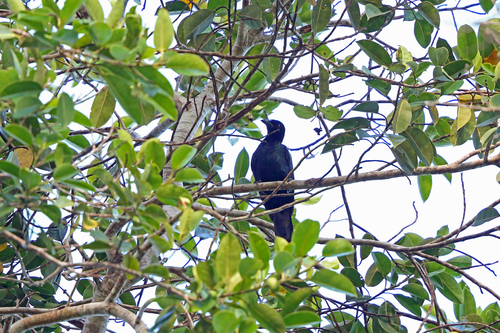 Jobi ManucodeManucodia jobiensisThe Jobi manucode is medium-sized, up to 34 cm (13 in) long, greenish blue, black and purple-glossed with red iris, lightly crinkled bluish short upper breast and neck feathers.
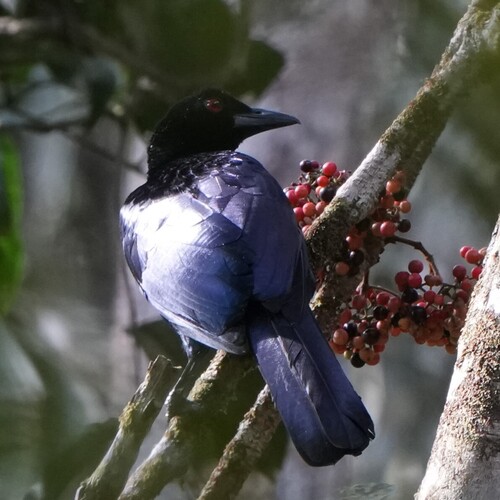 Crinkle-collared ManucodeManucodia chalybatusThe crinkle-collared manucode is medium-sized, up to 36 cm long, greenish blue, black and purple-glossed with a long graduated tail, red iris and iridescent green breast feathers.
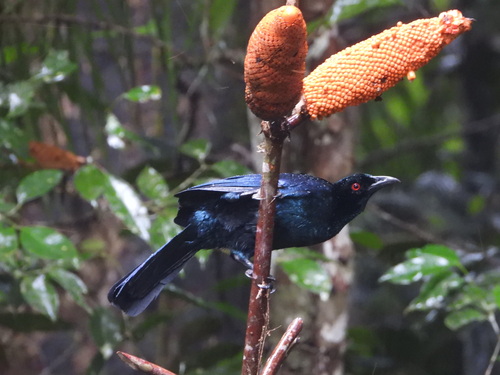 Glossy-mantled ManucodeManucodia aterThe glossy-mantled manucode is medium-sized, around 42 cm long, glossed green, blue and purple black with a red iris, black bill, long graduated tail and somewhat elongated upper breast and neck feathers.
Learn the Curl-crested Manucode in the BeakBrain App
Photo and call practice. Coming soon to iPhone and Android.
Play today's Daily BirdEvery photo and recording on this page is credited to its author under the licence shown. Spotted a problem with this page, or have a better photo? Contribute.