Learn what every symbol on the card means.Full credits and sources at beakbrain.com/symbols
 ShrublandPlatform nestLarge · 1.1 kg


What the Crested Caracara sounds like

ID tip
The crested caracara has a total length of 50–65 cm (20–26 in) and a wingspan of 120–132 cm (47–52 in). Its weight is 0.9–1.6 kg (2.0–3.5 lb), averaging 1,348 g (2.972 lb) in seven birds from Tierra del Fuego. Individuals from the colder southern part of its range average larger than those from tropical regions (as predicted by Bergmann's rule) and are the largest type of caracara. In fact, they are the second-largest species of falcon in the world by mean body mass, second only to the gyrfalcon.
Text from Wikipedia, licensed CC BY-SA 4.0.
When to see the Crested Caracara
One bar for each month, and every month is filled: this bird is recorded here in all twelve. The wide bar is January, the month with the most records.
Where to see the Crested Caracara
The map shades 28 countries with regular records, and 3 more in a lighter tone where the bird turns up only as a stray. Everything unshaded has no records. Countries are listed below the map.
About the Crested Caracara
The crested caracara is a bird of prey (raptor) in the falcon family, Falconidae. It was formerly placed in the genus Polyborus before being given in its own genus, Caracara. It is native to and found in the southern and southeastern United States, Mexico and the majority of mainland Latin America, as well as some Caribbean islands. The crested caracara is quite adaptable and hardy, for a species found predominantly in the neotropics; it can be found in a range of environments and ecosystems, including semi-arid and desert climates, maritime or coastal areas, subtropical and tropical forests, temperate regions, plains, swamps, and even in urban areas.
Text adapted from Wikipedia, licensed CC BY-SA 4.0.
Easily confused with
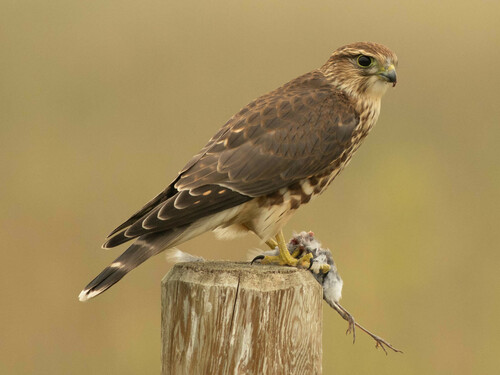 MerlinFalco columbariusThe merlin is 24–33 cm (9.4–13.0 in) long with a 50–73 cm (20–29 in) wingspan.
 Eurasian HobbyFalco subbuteoAdults are slate-grey above with a dark crown and two short black moustache stripes.
 Peregrine FalconFalco peregrinusThe peregrine falcon has a body length of 34 to 58 cm (13–23 in) and a wingspan from 74 to 120 cm (29–47 in).
Side by side: Crested Caracara vs Merlin · Crested Caracara vs Peregrine Falcon · Crested Caracara vs Eurasian Hobby
Learn the Crested Caracara in the BeakBrain App
Photo and call practice. Coming soon to iPhone and Android.
Play today's Daily BirdEvery photo and recording on this page is credited to its author under the licence shown. Spotted a problem with this page, or have a better photo? Contribute.