Learn what every symbol on the card means.Full credits and sources at beakbrain.com/symbols
 WoodlandCavity nestSmall · 44 g


What the Coppersmith Barbet sounds like


ID tip
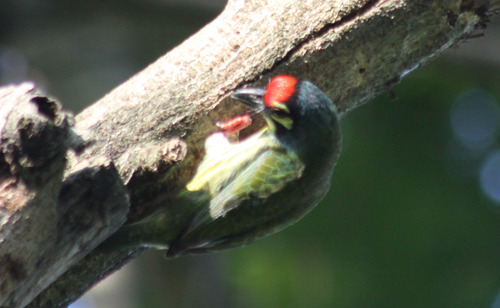
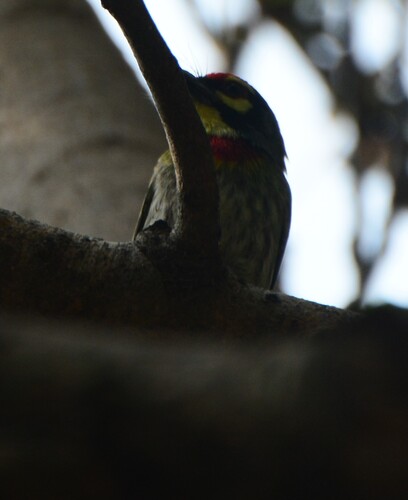
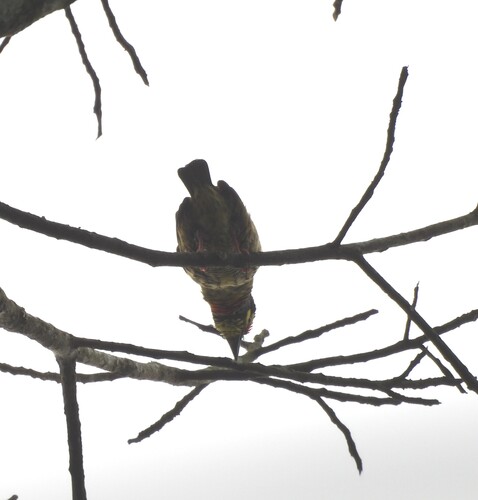
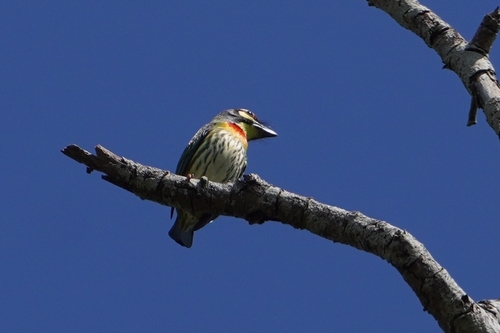
The coppersmith barbet is green with a red head, yellow cheeks and a yellow throat. Its underparts are streaked in grey and black. During the nesting season, the wear and tear on the feathers can cause the plumage of the upper back to appear bluish. It is 15–17 cm (5.9–6.7 in) long and weighs 30–52.6 g (1.06–1.86 oz). Voice: The call is a loud rather metallic tuk…tuk…tuk (or tunk), reminiscent of a copper sheet being beaten, giving the bird its name. Repeated monotonously for long periods, starting with a subdued tuk and building up to an even volume and tempo, the latter varying from 108 to 121 per minute and can continue with as many as 204 notes. They are silent and do not call in winter.
Text from Wikipedia, licensed CC BY-SA 4.0.
When to see the Coppersmith Barbet
One bar for each month, and every month is filled: this bird is recorded here in all twelve. The wide bar is February, the month with the most records.
Where to see the Coppersmith Barbet
The map shades 16 countries with regular records. Everything unshaded has no records. Countries are listed below the map.
About the Coppersmith Barbet
The coppersmith barbet, also called crimson-breasted barbet and coppersmith, is an Asian barbet with crimson forehead and throat, known for its metronomic call that sounds similar to a coppersmith striking metal with a hammer. It is a resident bird in the Indian subcontinent and parts of Southeast Asia. It carves out holes inside a tree to build its nest. It is predominantly frugivorous, but has been observed eating insects, especially winged termites.
Text adapted from Wikipedia, licensed CC BY-SA 4.0.
Easily confused with
 White-cheeked BarbetPsilopogon viridisThe white-cheeked barbet is 16.5–18.5 cm (6.5–7.3 in) in length.
 Taiwan BarbetPsilopogon nuchalisIt is about 20 cm (7.9 in) long.
 Brown-headed BarbetPsilopogon zeylanicusThe adult has a streaked brown head, neck and breast, and a yellow eye patch.
Side by side: Coppersmith Barbet vs White-cheeked Barbet · Coppersmith Barbet vs Taiwan Barbet · Brown-headed Barbet vs Coppersmith Barbet
Learn the Coppersmith Barbet in the BeakBrain App
Photo and call practice. Coming soon to iPhone and Android.
Play today's Daily BirdEvery photo and recording on this page is credited to its author under the licence shown. Spotted a problem with this page, or have a better photo? Contribute.