
White-eared Honeyeater
Nesoptilotis leucotis
The white-eared honeyeater has an olive-green upper and lower body; its wings and tail are a mix of brown, yellow and olive; the crown is dark grey with black streaks; its cheeks and throat are black; its ear-coverts are white. Its iris is red or brown (juvenile); its bill is black and its legs are dark grey. The white-eared honeyeater is a medium-sized honeyeater 19–22 centimetres (7.5–8.7 in) in length. There is no sexual dimorphism, with males and females looking alike. They weigh approximately 20 g (0.71 oz) and have a beak length of approximately 17 mm (0.67 in). Voice: Their voice is deep and mellow but slightly metallic chwok, chwok, chwok-whit and kwitchu, kwitchu; very sharply scratchy, metallic chwik!.
ID text from Wikipedia, CC BY-SA 4.0
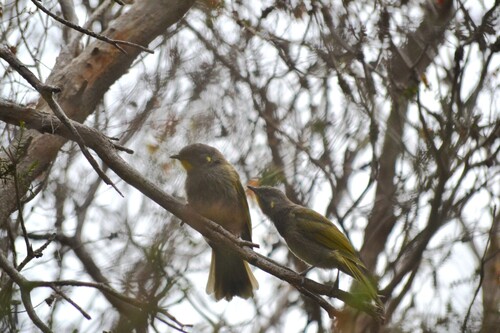
Yellow-throated Honeyeater
Nesoptilotis flavicollis
The yellow-throated honeyeater is a medium-sized honeyeater with a relatively long tail. Typical weight is 31 g (1.1 oz) and the average length is 21 cm (8.3 in). The plumage is bright olive-green above, with a silver-grey crown, face, and underbelly, contrasting with a distinctive bright yellow chin and throat. There is a small yellow ear-patch and the wing feathers are outlined with yellow. The bill is black and the eye is a deep ruby red. Females are smaller than males. Juvenile birds are very similar to adults, but duller. Voice: The yellow-throated honeyeater makes a variety of calls. These include a breeding call, used for attracting mates, and to advertise ownership of a territory. That call varies geographically, but essentially consists of a whirring chur-uk, chur-uk or a loud de-wit, and is used during breeding season. Another common call is a repeated tonk, tonk, tonk or tchook, tchook.
ID text from Wikipedia, CC BY-SA 4.0
Where you might meet both
Learn this pair in the BeakBrain App
Photo and call practice. Coming soon to iPhone and Android.
Play today's Daily BirdPhotos and recordings are credited to their authors under the licence shown. Full profiles: White-eared Honeyeater and Yellow-throated Honeyeater.