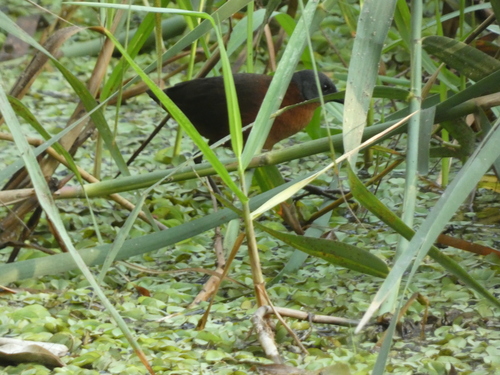
Ruddy Crake
Laterallus ruber
The ruddy crake can be identified by its ruddy plumage that can vary in shade and gray head with dark brown wings and tail. It is mostly bright chestnut in colour with a paler chin and belly, blackish crown and dark grey ear-coverts. Ruddy crakes are about the size of a sparrow. It is a small crake, 14–16.5 cm in length. Immature ruddy crakes tend to show discoloration on their midline or nape, such as a pale midline or chestnut colored nape. The bill is black, the iris is red and the legs and feet are olive-green.
ID text from Wikipedia, CC BY-SA 4.0

Spot-flanked Gallinule
Porphyriops melanops
The spot-flanked gallinule weighs between 154 and 225 grams, with an average length of 28 cm, often described as a small waterfowl-like bird. Its head, chin, neck and breast feathers are a slate gray, contrasting with the black forehead and crown, extending to the top of the nape. Its covert feathers are a brown, cocoa-like, color while primary feathers tend to have a slight color contrast and are a darker shade of brown. As the name suggests, the flanks of this species is brown with white mottling with its rump a mix of the same shades of brown and white. Voice: The spot-flanked gallinule can produce a variety of sounds at different pitches which often differs depending on locale, sounding as if it is cackling, making a ke-ke-ke-ke like sound. Its alternative call is quick clicking sound. Its song includes the high pitched ke-ke-ke-ke cackling sound along with a low pitch whooping sound.
ID text from Wikipedia, CC BY-SA 4.0
Learn this pair in the BeakBrain App
Photo and call practice. Coming soon to iPhone and Android.
Play today's Daily BirdPhotos and recordings are credited to their authors under the licence shown. Full profiles: Ruddy Crake and Spot-flanked Gallinule.