
Red-rumped Cacique
Cacicus haemorrhous
Male red-rumped caciques average 29 cm (11 in) long and 96.5 g (3.4 oz). Females average 25 cm (9.8 in) long and weigh 62 to 74 g (2.2 to 2.6 oz). The sexes have essentially the same plumage though females are overall duller than males. Adults of the nominate subspecies C. h. haemorrhous are mostly glossy black with a bright red lower back and rump. Males have a pale blue iris and females a brownish blue iris. Both sexes have an ivory-colored bill and black legs and feet. Juveniles resemble adult females. Subspecies C. h. Voice: The red-rumped cacique has a "oud, complex and varied repertoire of songs and calls, particularly among males". They have been described as an "unstructured series of high, hoarse sreek sreek... notes (not unlike barking of small dog)." When alarmed all the members of a colony give "a loud harsh kak-kak-kak.
ID text from Wikipedia, CC BY-SA 4.0
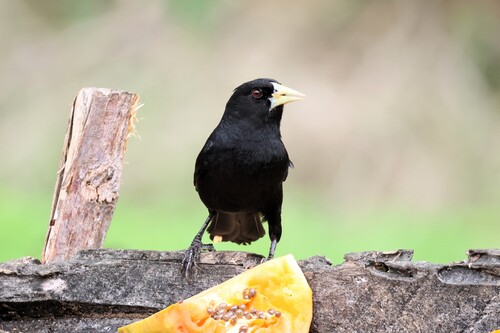
Solitary Cacique
Cacicus solitarius
The male solitary cacique has a length of about 27 cm (10.6 in) and the female 23 cm (9.1 in). It differs from all other entirely black birds with dark irises within its range, by having a large white, chisel-shaped, sharply-pointed beak. It could be confused with the Ecuadorian cacique (Cacicus sclateri), but that is smaller and has a restricted range, or the yellow-billed cacique (Amblycercus holosericeus), but that is not found east of the Andes. It has a range of different vocalizations which are mostly delivered at a measured pace but are sometimes interrupted by gurgles and growls.
ID text from Wikipedia, CC BY-SA 4.0

Where you might meet both
Learn this pair in the BeakBrain App
Photo and call practice. Coming soon to iPhone and Android.
Play today's Daily BirdPhotos and recordings are credited to their authors under the licence shown. Full profiles: Red-rumped Cacique and Solitary Cacique.