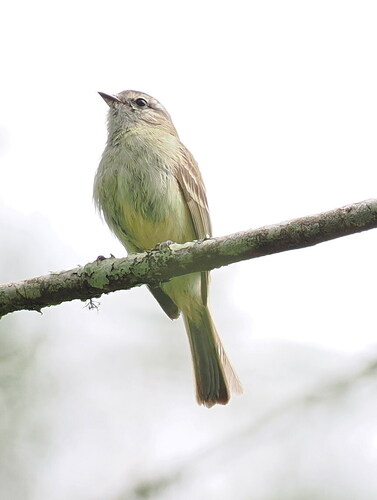
Planalto Tyrannulet
Phyllomyias fasciatus
The planalto tyrannulet is 11 to 11.5 cm (4.3 to 4.5 in) long. The sexes have the same plumage. Adults of the nominate subspecies have dull grayish-olive to brownish-olive crowns, napes, backs, and rumps, with the crown being the grayest part. Their lores, supercilium, partial eyering, and lower face are whitish with a dark stripe through their eye. Their wings are dusky with pale olive to whitish edges to the flight feathers and the ends of the coverts; the latter show as two pale bars on the closed wing. Their tail is dusky. Voice: The planalto tyrannulet's song differs geographically. In the southeastern part of its range it sings "a slow series of 3-4 slightly descending, plaintive 'puh-puh--' minor-key notes". Elsewhere it sings a "slightly higher-pitched and more distinctly descending series of 3 more major-keyed notes".
ID text from Wikipedia, CC BY-SA 4.0

Sclater's Tyrannulet
Phyllomyias sclateri
Sclater's tyrannulet is 11.5 to 12.5 cm (4.5 to 4.9 in) long. The sexes have the same plumage. Adults of the nominate subspecies have a dull olive-green crown, nape, back, and rump with a grayish tinge on the crown. They have whitish lores and narrow supercilium. Their wings are dusky with pale yellow to whitish edges on the flight feathers and the ends of the coverts; the last show as two bars on the closed wing. Their tail is dusky olive. Their throat is grayish white and their lower face grizzled whitish. Their breast is pale gray that becomes pale yellowish on their flanks and belly. Voice: What is thought to be the song of Sclater's tyrannulet is "a deep, gruff chanting: djeer djeer djeer djeer interspersed with sharper tchik tchik thcik notes".
ID text from Wikipedia, CC BY-SA 4.0
Where you might meet both
Learn this pair in the BeakBrain App
Photo and call practice. Coming soon to iPhone and Android.
Play today's Daily BirdPhotos and recordings are credited to their authors under the licence shown. Full profiles: Planalto Tyrannulet and Sclater's Tyrannulet.