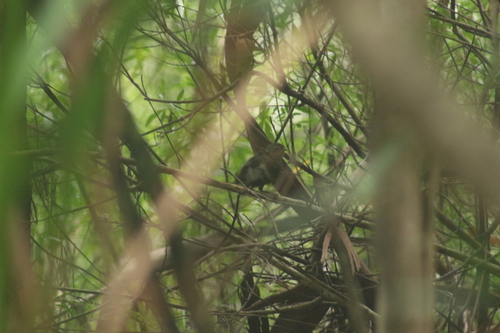
Pilotbird
Pycnoptilus floccosus
The pilotbird is a large, plump species of acanthizid, measuring around 18 centimetres (7.1 in) in length and weighing 27 grams (0.95 oz). The plumage of the underparts is reddish-brown with scalloping on the chest and the centre of the belly speckled dull white. The upperparts are chocolate-brown. The bill is short and finely pointed. Its tail is broad and semi-erect, and flicked up and down when feeding.
ID text from Wikipedia, CC BY-SA 4.0
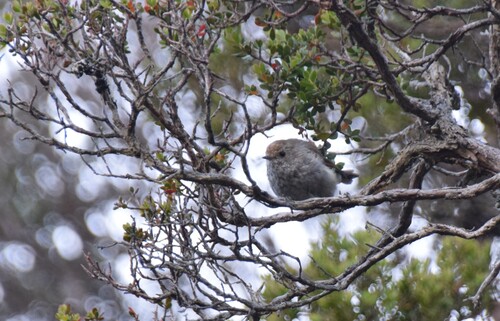
Tasmanian Thornbill
Acanthiza ewingii
The Tasmanian Thornbill is olive-brown above, darkening toward the back and tail, and can exhibit a patch of reddish-brown colouration on the forehead. The wings are dark grey with olive-brown edge lining. Grey on light grey scalloping is present from the chin to breast, with similar scalloping occurring on the sides of the head. The bill, feet, and legs are all dark grey and the eyes are distinctly large and dark, with red irises. It's long, thin, thorn-shaped beak is a distinguishing characteristic of the Acanthiza (thornbill) family. Voice: The Tasmanian Thornbill has the warbling style of call that is characteristically attributed to the Acanthizidae (Australian warbler) family, and its main call has been described phonetically as a zit zit zit sound.
ID text from Wikipedia, CC BY-SA 4.0
Where you might meet both
Learn this pair in the BeakBrain App
Photo and call practice. Coming soon to iPhone and Android.
Play today's Daily BirdPhotos and recordings are credited to their authors under the licence shown. Full profiles: Pilotbird and Tasmanian Thornbill.