
Palm-nut Vulture
Gypohierax angolensis
This is a nearly unmistakable bird as an adult. At 1.3–1.7 kg (2.9–3.7 lb) in weight, 60 cm (2.0 ft) in length and with a wingspan of 1.50 m (4.9 ft), this is the smallest Old World vulture. Its plumage is all white except for black areas in its wings and tail. It has a red patch around each eye. The juvenile, which takes 3–4 years to mature, is brown with yellow eye-patches. In flight, this species resembles an eagle more than a typical vulture, and it can sustain flapping flight, so it does not depend on thermals.
ID text from Wikipedia, CC BY-SA 4.0
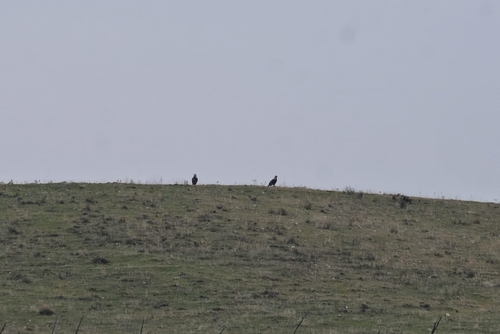
Spanish Imperial Eagle
Aquila adalberti
This is a large raptor and quite large eagle, broadly similar in size to its cousin, the eastern imperial eagle, which is found in a considerably different distributional range. Compared to sympatric largish booted eagles, it is somewhat smaller than the golden eagle and somewhat larger than Bonelli's eagle. Spanish imperial eagles can weigh from 2.5 to 4.8 kg (5.5 to 10.6 lb). The average weight of males in a sample of 10 was 3.19 kg (7.0 lb) while that of 17 females was found to be 3.43 kg (7.6 lb). Meanwhile, another sample of 10 unsexed adults weighed an average of 3.93 kg (8.7 lb).
ID text from Wikipedia, CC BY-SA 4.0
Learn this pair in the BeakBrain App
Photo and call practice. Coming soon to iPhone and Android.
Play today's Daily BirdPhotos and recordings are credited to their authors under the licence shown. Full profiles: Palm-nut Vulture and Spanish Imperial Eagle.