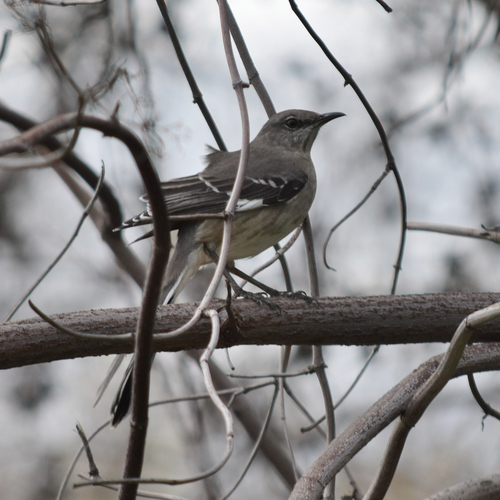
Northern Mockingbird
Mimus polyglottos
The northern mockingbird is a medium-sized mimid that has long legs and tail. Males and females look alike. Its upper parts are colored gray, while its underparts have a white or whitish-gray color. It has parallel wing bars on the half of the wings connected near the white patch giving it a distinctive appearance in flight. The black central rectrices and typical white lateral rectrices are also noticeable in flight. The iris is usually a light green-yellow or a yellow, but there have been instances of an orange color. The bill is black with a brownish black appearance at the base. Voice: Although many species of bird imitate the vocalizations of other birds, the northern mockingbird is the species best known in North America for doing so.
ID text from Wikipedia, CC BY-SA 4.0

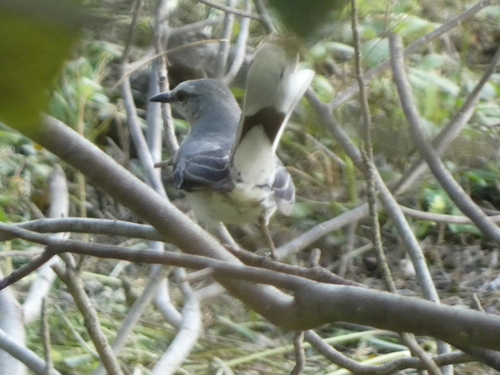
Tropical Mockingbird
Mimus gilvus
Adult tropical mockingbirds are 23 to 25.5 cm (9.1 to 10.0 in) long. The mean weights of various subspecies vary greatly. Adults of the nominate subspecies are gray on the head and upper parts and have a whitish supercilium and a dark stripe through the eye. The underparts are off-white and the wings are blackish with two white wing bars and white edges to the flight feathers. They have a long dark tail with white feather tips, a slim black bill with a slight downward curve and long dark legs. Juveniles are browner and their chest and flanks have dusky streaks. Voice: The tropical mockingbird's song is "a varied and long-continued sequence of diverse mellow to harsh notes, trills, with considerable repetition of phrases". It will often sing through the night. It apparently rarely mimics other species. Its calls include "a resonant 'pree-ew'" and "a harsh 'chick' or 'chek'".
ID text from Wikipedia, CC BY-SA 4.0

Where you might meet both
Learn this pair in the BeakBrain App
Photo and call practice. Coming soon to iPhone and Android.
Play today's Daily BirdPhotos and recordings are credited to their authors under the licence shown. Full profiles: Northern Mockingbird and Tropical Mockingbird.