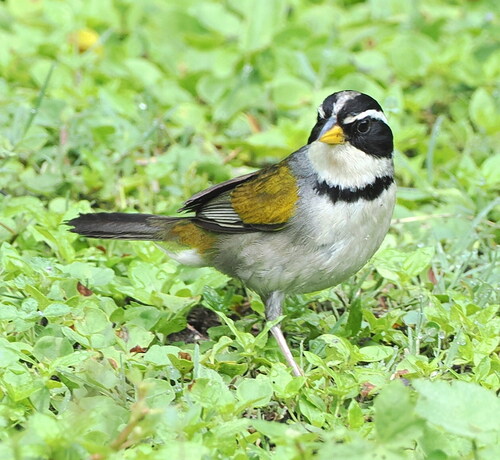
Moss-backed Sparrow
Arremon dorbignii
The adult male moss-backed sparrow's head is mostly black, with a white supercilium from the lores to the back of the head and a narrow gray streak on the crown. The neck is gray and the back, wings, and tail are dull olive green. Its underside is white with grayish edges and a narrow black band across the upper chest. The adult female is similar but duller overall. The crown strip is olive and the underparts are buffy with brown flanks. Juveniles are similar to the adults but duller. The moss-backed sparrow shares the "striking orange bill" of its former "parent" saffron-billed sparrow.
ID text from Wikipedia, CC BY-SA 4.0
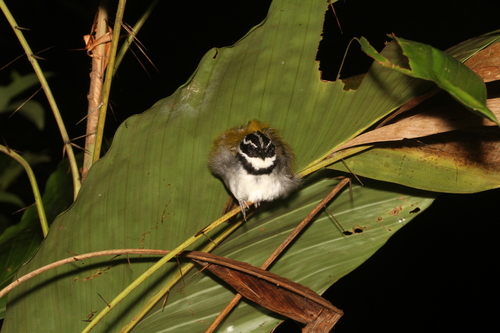
Pectoral Sparrow
Arremon taciturnus
The pectoral sparrow is sexually dimorphic, and, as the name implies, sparrow-sized, at 15 cm (5.9 in) in length and 24 g (0.85 oz) in weight. Its upperparts are pale green, becoming yellow near the bend of the wing. The head is black, with white on its throat and as stripes on its crown. Its underparts are white in males and creamy in females, with males also having a broad black band going across its breast (a pectoral band). The beak is also black, roughly 14–15 mm (0.55–0.59 in) long for both males and females. Tails are 58–60 and 64–67 mm (2.3–2.4 and 2.5–2. Voice: The song of the pectoral sparrow is a high-pitched buzz, consisting of very short tzik notes (initial tzik note may be slightly faster, and lower in pitch.) and usually followed by 2-4 longer, almost identical tzzzzzz notes. The entire song lasts for 2–3 seconds, at a pitch of 8 kilohertz.
ID text from Wikipedia, CC BY-SA 4.0
Where you might meet both
Learn this pair in the BeakBrain App
Photo and call practice. Coming soon to iPhone and Android.
Play today's Daily BirdPhotos and recordings are credited to their authors under the licence shown. Full profiles: Moss-backed Sparrow and Pectoral Sparrow.