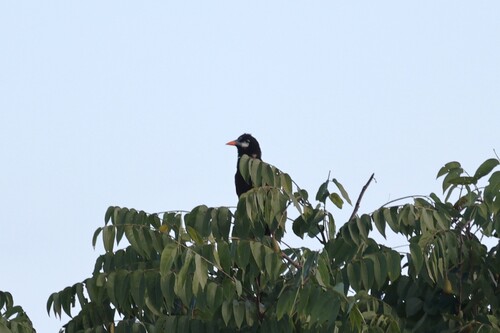
Montezuma Oropendola
Psarocolius montezuma
Adult males are mainly chestnut with a blackish head and rump, and a tail which is bright yellow apart from two dark central feathers. There is a bare blue cheek patch and a pink wattle, the iris is brown, and the long bill is black at the base with a red tip. Females are similar, but smaller than males with a smaller wattle. Young birds are duller than adults and have a paler and less demarcated bill. No subspecies are currently recognized. Voice: The "unforgettable" song of the male Montezuma oropendola is given during the bowing display, and consists of a conversational bubbling followed by loud gurgles, tic-tic-glik-glak-GLUUuuuuu. Both sexes have loud cack and crrrk calls. In a recent study by on male Montezuma oropendolas, researchers found that, when at breeding sites, males often changed the lowest peak frequency.
ID text from Wikipedia, CC BY-SA 4.0
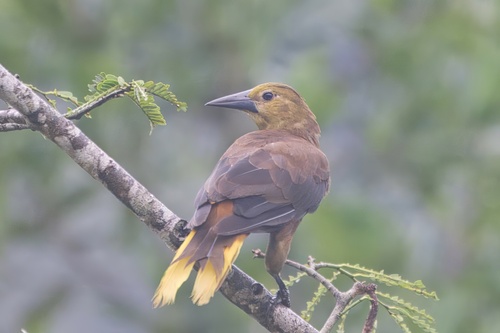
Russet-backed Oropendola
Psarocolius angustifrons
Russet-backed oropendola males are 44 to 48 cm (17 to 19 in) long and females 34 to 38 cm (13 to 15 in). Males weigh about 250 to 470 g (8.8 to 17 oz) and females about 170 to 230 g (6.0 to 8.1 oz). Adult males have long feathers on their nape that form a crest and females do not; their plumage is otherwise the same. Adult males of the nominate subspecies P. a. angustifrons have an olivaceous-brown head and a mostly brown body and wings with a russet tinge. Their rump and uppertail coverts are paler russet-brown.
ID text from Wikipedia, CC BY-SA 4.0

Learn this pair in the BeakBrain App
Photo and call practice. Coming soon to iPhone and Android.
Play today's Daily BirdPhotos and recordings are credited to their authors under the licence shown. Full profiles: Montezuma Oropendola and Russet-backed Oropendola.