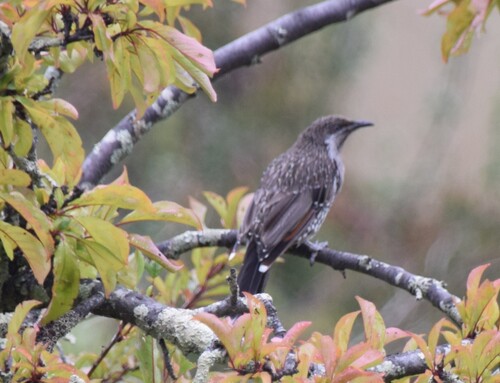
Little Wattlebird
Anthochaera chrysoptera
The little wattlebird is a medium to large honeyeater, but the smallest wattlebird. The appearance is similar to the yellow wattlebird and the red wattlebird. The little wattlebird lacks the wattles, which characterise other members of the genus. Juveniles are duller with less streaking and have a browner eye. Calls include a strident cookay-cok, a raucous fetch the gun, a mellow guttural yekkop, yekkop and many squeaky, musical lilting notes. The alarm call is a kwock or shnairt!.
ID text from Wikipedia, CC BY-SA 4.0
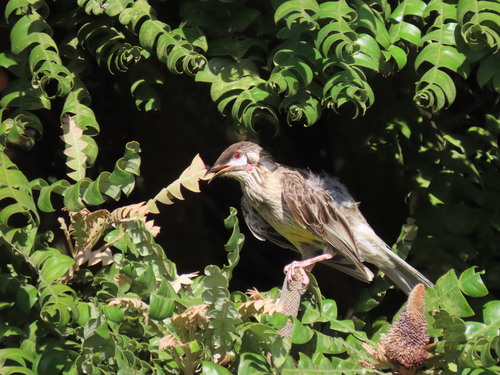
Red Wattlebird
Anthochaera carunculata
The sexes of the red wattlebird are similar in size and plumage, the length of the adult male ranging from 33 to 37 centimetres (13 to 15 in) and the adult female from 34 to 37 centimetres (13 to 15 in). With an average weight of 100–120 grams (3.5–4.2 oz), the red wattlebird is one of the largest nectar-feeding birds in the world, and the second largest species of honeyeater native to Australia, eclipsed only by the yellow wattlebird. Voice: Red wattlebirds are noisy animals, producing a range of raucous calls. Pairs of birds appear to duet, particularly at food sources, with the male producing a loud cackle and the female a whistling call. The male's cackle is loudest between 1 and 3 kHz frequency. A guttural-sounding call, it has been variously described as having a squawking, coughing or hiccuping sound.
ID text from Wikipedia, CC BY-SA 4.0

Where you might meet both
Learn this pair in the BeakBrain App
Photo and call practice. Coming soon to iPhone and Android.
Play today's Daily BirdPhotos and recordings are credited to their authors under the licence shown. Full profiles: Little Wattlebird and Red Wattlebird.