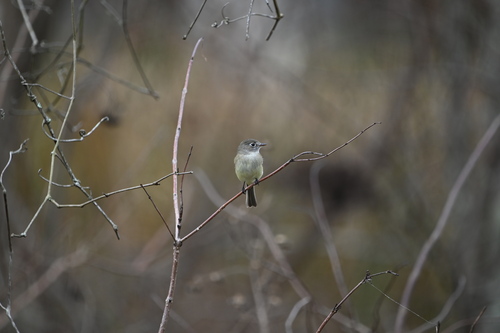
Least Flycatcher
Empidonax minimus
The least flycatcher is hard to distinguish from the other birds of its genus. The bird is one of the smallest of the genus Empidonax, measuring 12 to 14 cm in height with a wingspan of 19 to 22 cm and weighing approximately 10.3 g. Its plumage is dull olive-gray on its back and whitish on its belly, notably brighter than the other Empidonax birds. The least flycatcher's wings are lined with two white bars, and white rings contour its eyes. Its beak is short and the lower mandible is yellowish. Voice: The vocalization of the least flycatcher is often characterized as being dry and sounding like a piercing «che-bec» pushed with strength, the second syllable being louder than the first. During the hottest days of the summer, they often call incessantly. Singing is essential to the least flycatcher to establish and defend their territory.
ID text from Wikipedia, CC BY-SA 4.0


Western Flycatcher
Empidonax difficilis
Adults have olive-gray upperparts, darker on the wings and tail, with yellowish underparts; they have a conspicuous teardrop-shaped white eye ring, white wing bars, a small bill and a short tail. It differs only subtly from most Empidonax flycatchers in North America, but its breeding habitat and call are different. Many species of this genus look closely alike. The best ways to distinguish species are by voice, by breeding habitat, and by range.
ID text from Wikipedia, CC BY-SA 4.0

Where you might meet both
Learn this pair in the BeakBrain App
Photo and call practice. Coming soon to iPhone and Android.
Play today's Daily BirdPhotos and recordings are credited to their authors under the licence shown. Full profiles: Least Flycatcher and Western Flycatcher.