
Lappet-faced Vulture
Torgos tracheliotos
The lappet-faced vulture is a very large species, ranking as the longest and largest winged vulture in its range, behind the closely related cinereous vulture, although some co-occurring Gyps vultures tend to be heavier on average, especially the Cape vulture and Eurasian griffon. This species measures around 95–115 cm (37–45 in) in body length, with a wingspan of 2.5–2.9 m (8.2–9.5 ft). Among the standard measurements, the wing chord is 71.5–82.5 cm (28.1–32.5 in), the tail is 33–36 cm (13–14 in) and the tarsus is 12.2–15 cm (4.8–5.9 in). The bill, at up to 10 cm (3.9 in) long and 5 cm (2.
ID text from Wikipedia, CC BY-SA 4.0
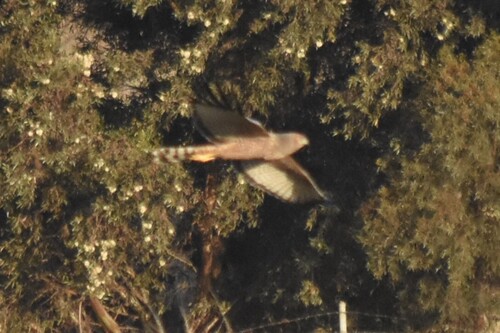
Spotted Harrier
Circus assimilis
The spotted harrier is a medium-sized, slender bird of prey with adult females reaching 58–61 cm. Both adults and juvenile birds have an owl-like facial ruff that creates the appearance of a short, broad head as well as long yellow legs. The spotted harrier's wings feature prominent black tips and the tail is prominently barred and slightly wedge shaped. Adult males are much smaller than the females only growing to 50–55 cm. Adult birds have blue to grey upper parts with a chestnut face and underparts that feature numerous white spots.
ID text from Wikipedia, CC BY-SA 4.0
Learn this pair in the BeakBrain App
Photo and call practice. Coming soon to iPhone and Android.
Play today's Daily BirdPhotos and recordings are credited to their authors under the licence shown. Full profiles: Lappet-faced Vulture and Spotted Harrier.