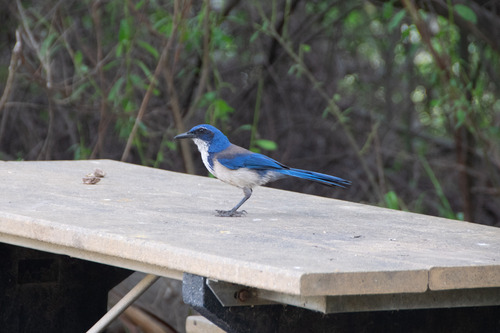
Island Scrub Jay
Aphelocoma insularis
The island scrub jay is closely related to the California scrub jay (the coastal population found on the adjacent mainland), but differs in being larger, more brightly colored, and having a markedly stouter bill. They will bury, or cache, the acorns in the fall and may eat them months later. They also eat insects, spiders, snakes, lizards, mice and other birds' eggs and nestlings.
ID text from Wikipedia, CC BY-SA 4.0
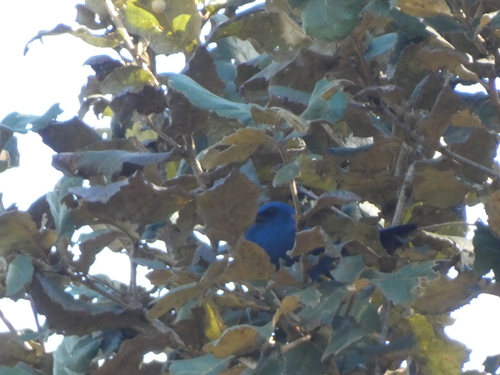
Unicolored Jay
Aphelocoma unicolor
The unicolored jay is about 34 cm (13 in) long. The nominate subspecies A. u. unicolor weighs about 125 to 150 g (4.4 to 5.3 oz). The sexes have the same plumage. The nominate subspecies is entirely deep blue to purplish blue that is somewhat darker on the sides of the head and the throat. Juveniles are a slightly bluish gray that is duller than adult plumage. Subspecies A. u. griscomi has the same plumage as the nominate. A. u. guerrerensis is the most purplish subspecies, A. u. concolor is a paler blue than the nominate, and A. u. oaxacae is somewhat darker than the nominate. Voice: Though recordings of unicolored jay vocalizations come from most of its range, detailed analyses come primarily from the Montebello studies. The birds there made hundreds of variants of their calls though many were only subtly different from each other. The calls were described as grating/harsh, musical/resonant, whistled, loud, and soft.
ID text from Wikipedia, CC BY-SA 4.0
Learn this pair in the BeakBrain App
Photo and call practice. Coming soon to iPhone and Android.
Play today's Daily BirdPhotos and recordings are credited to their authors under the licence shown. Full profiles: Island Scrub Jay and Unicolored Jay.