
Indian Robin
Copsychus fulicatus
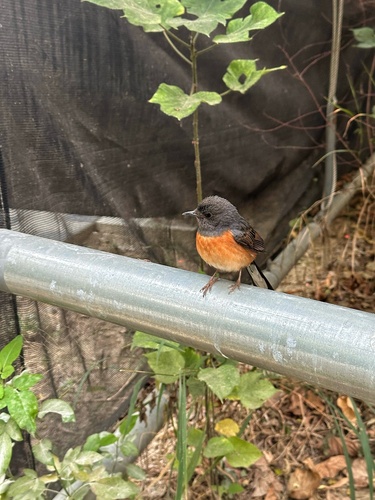
The Indian robin is sexually dimorphic in plumage, with the male being mainly black with a white shoulder patch or stripe whose visible extent can vary with posture. The northern populations have the upper plumage brownish, while the southern populations are black above. The males have chestnut undertail coverts and these are visible as the bird usually holds the 6–8 cm long tail raised upright. The females are brownish above, have no white shoulder stripe and are greyish below, with the vent a paler shade of chestnut than the males.
ID text from Wikipedia, CC BY-SA 4.0

White-rumped Shama
Copsychus malabaricus
They typically weigh between 28 and 34 g (1.0 and 1.2 oz) and are around 23–28 cm (9–11 in) in length. Males are glossy black with a chestnut belly and white feathers on the rump and outer tail. Females are more greyish-brown, and are typically shorter than males. Both sexes have a black bill and pink feet. Juveniles have a greyish-brown colouration, similar to that of the females, with a blotchy or spotted chest. Voice: The voice of this species is rich and melodious which makes them popular as cage birds in South Asia with the tradition continuing in parts of Southeast Asia. It is loud and clear, with a variety of phrases, and often mimics other birds. They also make a 'Tck' call in alarm or when foraging. The earliest known recording of bird song was made of an individual of this species in 1889 by Ludwig Koch.
ID text from Wikipedia, CC BY-SA 4.0
Where you might meet both
Learn this pair in the BeakBrain App
Photo and call practice. Coming soon to iPhone and Android.
Play today's Daily BirdPhotos and recordings are credited to their authors under the licence shown. Full profiles: Indian Robin and White-rumped Shama.