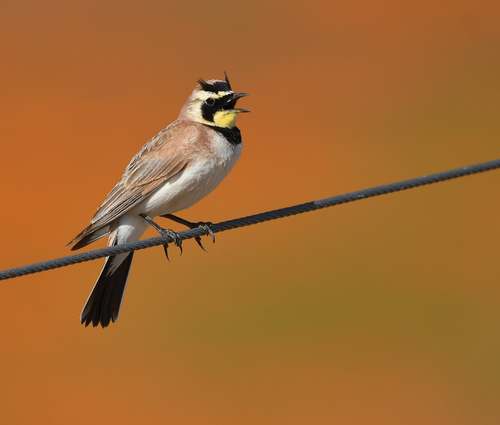
Horned Lark
Eremophila alpestris
Unlike most other larks, this is a distinctive-looking species on the ground, mainly brown-grey above and pale below, with a striking black and yellow face pattern. Except for the central feathers, the tail is mostly black, contrasting with the paler body; this contrast is especially noticeable when the bird is in flight. The summer male has black "horns", two tufts of feathers on its head which give this species its American name. North America has a number of races distinguished by the face pattern and back colour of males, especially in summer. The southern European mountain race E. a.
ID text from Wikipedia, CC BY-SA 4.0

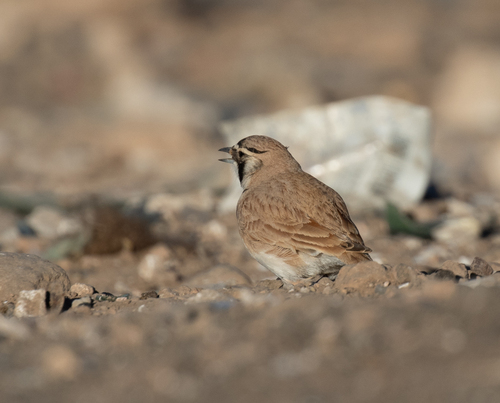
Temminck's Lark
Eremophila bilopha
Unlike most other larks, Temminck's lark is a distinctive looking species on the ground, similar to the other, larger, member of its genus, the horned lark. The 14 to 15 cm (5.5 to 5.9 in) adult is mainly reddish brown-grey above and pale below, and it has a striking black and white face pattern and a distinctive black patch on its breast. The summer male has black "horns", which give this species its alternative name. The juvenile of this species is reddish above and pale below, quite unlike the juvenile horned lark.
ID text from Wikipedia, CC BY-SA 4.0
Where you might meet both
Learn this pair in the BeakBrain App
Photo and call practice. Coming soon to iPhone and Android.
Play today's Daily BirdPhotos and recordings are credited to their authors under the licence shown. Full profiles: Horned Lark and Temminck's Lark.