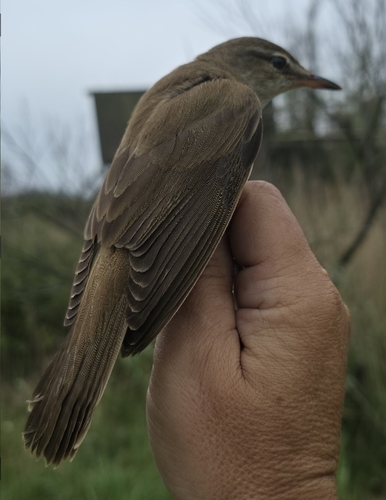
Great Reed Warbler
Acrocephalus arundinaceus
The thrush-sized warbler is one of the largest species in both its current the family Acrocephalidae, and its former family, the "Sylviidae". It measures 16–21 cm (6.3–8.3 in) in length, 25 to 30 cm (9.8 to 11.8 in) in wingspan and weighs 22 to 38 g (0.78 to 1.34 oz). The adult has unstreaked brown upperparts and dull buffish-white chin and underparts. The forehead is flattened, and the bill is strong and pointed. It looks very much like a giant common reed warbler (Acrocephalus scirpaceus), but with a stronger supercilium.
ID text from Wikipedia, CC BY-SA 4.0

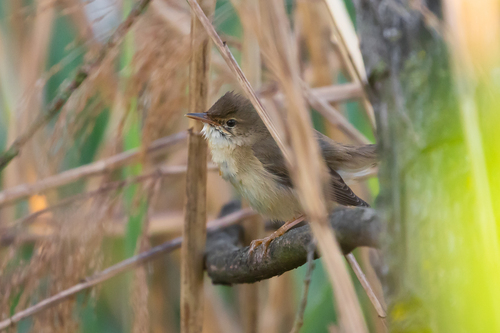
Marsh Warbler
Acrocephalus palustris
This is a medium-sized warbler. It is very similar in appearance to several other acrocephaline warblers, such as the reed warbler which also occurs in wetlands and has a similar breeding range. The male's distinctive song is useful for identification, as no other member of the genus mimics other birds to any significant extent. The marsh warbler also tends to avoid the stands of pure reed which are the reed warbler's favoured habitat. The sexes are alike in appearance. Hybridisation with both reed warbler and Blyth's reed warbler has been occasionally recorded.
ID text from Wikipedia, CC BY-SA 4.0

Where you might meet both
And 39 more countries.
Learn this pair in the BeakBrain App
Photo and call practice. Coming soon to iPhone and Android.
Play today's Daily BirdPhotos and recordings are credited to their authors under the licence shown. Full profiles: Great Reed Warbler and Marsh Warbler.