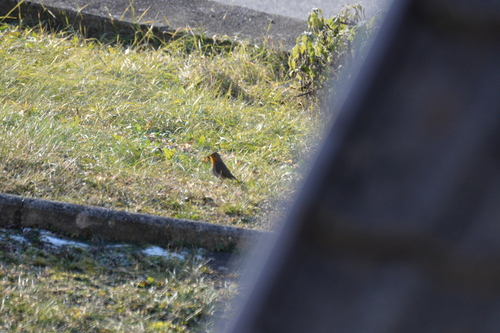
European Robin
Erithacus rubecula
The adult European robin is 12.5–14.0 cm (4.9–5.5 in) long and weighs 16–22 g (0.56–0.78 oz), with a wingspan of 20–22 cm (8–8.5 in). The male and female bear similar plumage: an orange breast and face (more strongly coloured in the otherwise similar British subspecies E. r. melophilus), lined by a bluish grey on the sides of the neck and chest. The upperparts are brownish, or olive-tinged in British birds, and the belly whitish, while the legs and feet are brown. The bill and eyes are black. Juveniles are a spotted brown and white in colouration, with patches of orange gradually appearing. Voice: The robin produces a fluting, warbling during the breeding season. Both the male and female sing throughout the year, including during the winter, when they hold separate territories. During the winter, the robin's song is more plaintive than the summer version. The female robin moves a short distance from the summer nesting territory to a nearby area that is more suitable for winter feeding.
ID text from Wikipedia, CC BY-SA 4.0


European Stonechat
Saxicola rubicola
The stonechat is 11.5–13 cm (4.5–5.1 in) long and weighs 13–17 g (0.46–0.60 oz), slightly smaller than the European robin. Both sexes have distinctively short wings, shorter than those of the more migratory whinchat and Siberian stonechat. The summer male has black upperparts, a black head, an orange throat and breast, and a white belly and vent. It also has a white half-collar on the sides of its neck, a small white scapular patch on the wings, and a very small white patch on the rump often streaked with black.
ID text from Wikipedia, CC BY-SA 4.0

Where you might meet both
And 43 more countries.
Learn this pair in the BeakBrain App
Photo and call practice. Coming soon to iPhone and Android.
Play today's Daily BirdPhotos and recordings are credited to their authors under the licence shown. Full profiles: European Robin and European Stonechat.