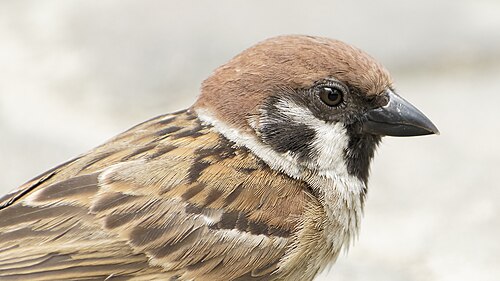
Eurasian Tree Sparrow
Passer montanus
The tree sparrow is 12.5–14 cm (5–5+1⁄2 in) long, with a wingspan of about 21 cm (8.3 in) and a weight of 24 g (0.85 oz), making it roughly 10% smaller than the house sparrow. The adult's crown and nape are rich chestnut, and there is a kidney-shaped black ear patch on each pure white cheek; the chin, throat, and the area between the bill and throat are black. The upperparts are light brown, streaked with black, and the brown wings have two distinct narrow white bars. The legs are pale brown, and the bill is lead-blue in summer, becoming almost black in winter.
ID text from Wikipedia, CC BY-SA 4.0


Spanish Sparrow
Passer hispaniolensis
The Spanish sparrow is a rather large sparrow, at 15–16 cm (6–6.5 in) in length, and 22–36 g (0.78–1.27 oz) in weight. It is slightly larger and heavier than house sparrows, and also has a slightly longer and stouter bill. The male is similar to the house sparrow in plumage, but differs in that its underparts are heavily streaked with black, has a chestnut rather than grey crown, and has white rather than grey cheeks. The female is effectively inseparable from the house sparrow in its basic plumage, which is grey-brown overall but more boldly marked. Voice: The Spanish sparrow's vocalisations are similar to those of the house sparrow. The male gives a call somewhat different from that of the house sparrow when displaying at its nest. This call is a pair of strident, disyllabic chirps, similar to those of the house sparrow, but louder and high-pitched, transcribed as chweeng-chweeng, cheela-cheeli.
ID text from Wikipedia, CC BY-SA 4.0

Where you might meet both
And 13 more countries.
Learn this pair in the BeakBrain App
Photo and call practice. Coming soon to iPhone and Android.
Play today's Daily BirdPhotos and recordings are credited to their authors under the licence shown. Full profiles: Eurasian Tree Sparrow and Spanish Sparrow.