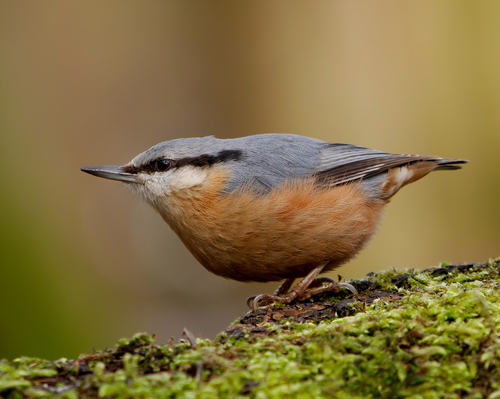
Eurasian Nuthatch
Sitta europaea
The adult male of the nominate subspecies, S. e. europaea is 14 cm (5.5 in) long with a 22.5–27 cm (8.9–10.6 in) wingspan. It weighs 17–28 g (0.6–1 oz). It has blue-grey upperparts, a black eye-stripe and whitish throat and underparts. The flanks and lower belly are orange-red, mottled with white on the undertail. The stout bill is dark grey with a paler area on the base of the lower mandible, the iris is dark brown and the legs and feet are pale brown or greyish. Most other members of the S. e. Voice: The Eurasian nuthatch calls frequently, usually with a loud, sharp dwip normally repeated twice, sometimes more often if excited. It has a shrill sirrrr or tsi-si-si alarm call, and a thin tsit pre-flight call. The song is a slow whistled pee-pee-pee with many variants, including a faster version, and may be intermingled with the call. The song of the distinctive S. e.
ID text from Wikipedia, CC BY-SA 4.0


Pygmy Nuthatch
Sitta pygmaea
The pygmy nuthatch is 9–11 cm (3.5–4.3 in) long and with a wingspan of 19.7 cm (7.8 in), and weighs 9.3–11.4 g (0.33–0.40 oz). It ranges from southern British Columbia south through various discontinuous parts of the western U.S. (northwest U.S., Sierra Nevada range, southern Rockies, etc.), to central Mexico. It is usually found in pines (especially ponderosa pine), douglas-fir, and other conifers. Pygmy nuthatches clamber acrobatically in the foliage of these trees, feeding on insects and seeds; less often they creep along limbs or the trunk like bigger nuthatches.
ID text from Wikipedia, CC BY-SA 4.0
Learn this pair in the BeakBrain App
Photo and call practice. Coming soon to iPhone and Android.
Play today's Daily BirdPhotos and recordings are credited to their authors under the licence shown. Full profiles: Eurasian Nuthatch and Pygmy Nuthatch.