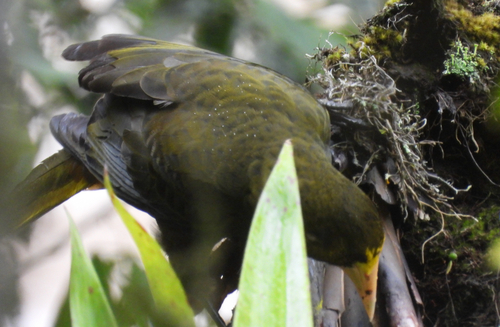
Dusky-green Oropendola
Psarocolius atrovirens
The male dusky-green oropendola grows to a length of about 42 cm (17 in) and the female of about 33 cm (13 in). The sexes are similar in morphology, the plumage being mainly dark brownish-green or blackish-green, with a rufous-brown rump and crissum (the undertail coverts surrounding the cloaca). The beak is greenish-white, there may be a few yellow feathers on the head, and the iris is brown or blue, the latter colour perhaps appearing in older birds.
ID text from Wikipedia, CC BY-SA 4.0

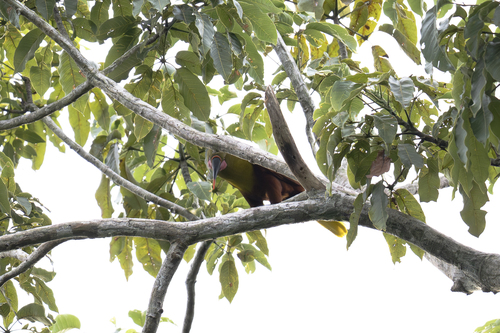
Olive Oropendola
Psarocolius bifasciatus
The olive oropendola is the largest member of its genus. Males are about 47 to 53 cm (19 to 21 in) long and females 34 to 38 cm (13 to 15 in). Adult males have long feathers on their nape that form a crest. Females lack the crest but are otherwise like males except for their smaller size and somewhat duller plumage. Adults of the nominate subspecies P. b. bifasciatus have a blackish brown head, neck, and upper breast that combined look like a hood. They have a patch of bare pinkish skin on their face.
ID text from Wikipedia, CC BY-SA 4.0

Where you might meet both
Learn this pair in the BeakBrain App
Photo and call practice. Coming soon to iPhone and Android.
Play today's Daily BirdPhotos and recordings are credited to their authors under the licence shown. Full profiles: Dusky-green Oropendola and Olive Oropendola.