
Common Nighthawk
Chordeiles minor
The common nighthawk is distinguished from other caprimulguids by its forked tail (includes a white bar in males); its long, unbarred, pointed wings with distinctive white patches; its lack of rictal bristles, and the key identifier – their unmistakable calls. These birds range from 21 to 25 cm (8.3 to 9.8 in) in total length and from 51 to 61 cm (20 to 24 in) in wingspan. Body mass can vary from 55 to 98 g (1.9 to 3.5 oz). Among standard measurements, the wing chord is 17.2 to 21.3 cm (6.8 to 8.4 in), the tail is 13 to 15.1 cm (5.1 to 5.9 in), the bill is 0.5 to 0.8 cm (0.20 to 0. Voice: There are no differences between the calls and song of the common nighthawk. The most conspicuous vocalization is a nasal peent or beernt during flight. Peak vocalizations are reported 30 to 45 minutes after sunset. A croaking auk auk auk is vocalized by males while in the presence of a female during courtship.
ID text from Wikipedia, CC BY-SA 4.0

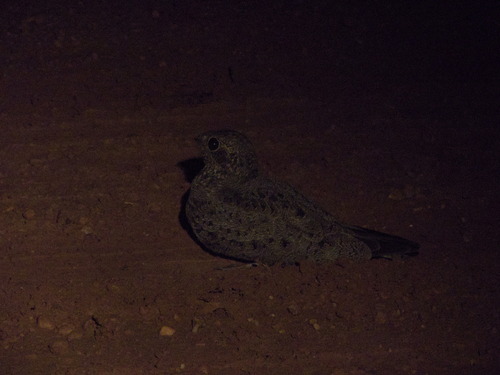
Nacunda Nighthawk
Chordeiles nacunda
The nacunda nighthawk is not only the largest of the highly aerial nightjars known as nighthawks and the largest species of nightjar in the neotropics, it is one of the largest nightjar species in the world. Its length, at 27.5 to 32 cm (10.8 to 12.6 in), is somewhat less than the great eared-nightjar, which is typically considered the largest species in the family, but the nacunda may actually weigh a bit more on average. Six specimens of nacunda nighthawk were found to average 159 g (5.6 oz) in body mass, with range of 130 to 188 g (4.6 to 6.6 oz).
ID text from Wikipedia, CC BY-SA 4.0
Where you might meet both
Learn this pair in the BeakBrain App
Photo and call practice. Coming soon to iPhone and Android.
Play today's Daily BirdPhotos and recordings are credited to their authors under the licence shown. Full profiles: Common Nighthawk and Nacunda Nighthawk.