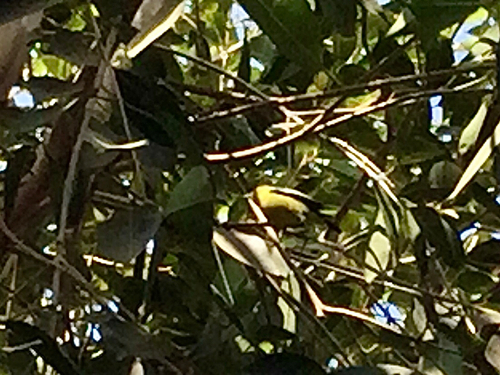
Common Iora
Aegithina tiphia
Ioras have a pointed and notched beak with a culmen that is straight. The common iora is sexually dimorphic, males in the breeding season have a black cap and back adding to a black wing and tail at all seasons. Females have greenish wings and an olive tail. The undersides of both are yellow and the two white bars on the wings of the male are particularly prominent in their breeding plumage. The males in breeding plumage have a very variable distribution of the black on the upperparts and can be confused with Marshall's iora, however, the latter always has white tips to the tail.
ID text from Wikipedia, CC BY-SA 4.0

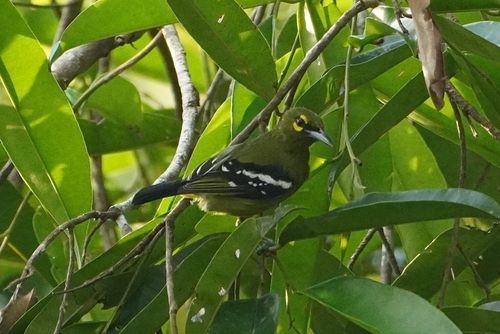
Green Iora
Aegithina viridissima
The green iora is 12–14 cm (4.7–5.5 in) long. The male has black lores and bright yellow "eyelids" (a broken eye-ring). The face and upperparts are dark olive. The wings are black, with two white wing-bars on the covert feathers and olive-yellow margins on the flight feathers. The underparts are also dark olive, with lighter flanks and a yellow centre belly. The tail is black. The eyes are dark to red brown, the beak is grey-blue, and the feet are slaty blue. The female has yellow lores and a complete eye-ring. The upperparts and tail are medium olive.
ID text from Wikipedia, CC BY-SA 4.0
Where you might meet both
Learn this pair in the BeakBrain App
Photo and call practice. Coming soon to iPhone and Android.
Play today's Daily BirdPhotos and recordings are credited to their authors under the licence shown. Full profiles: Common Iora and Green Iora.