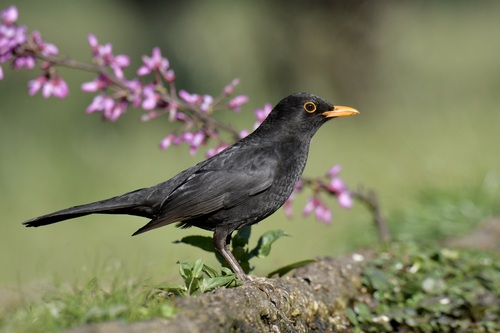
Common Blackbird
Turdus merula
In Europe, the common blackbird can be confused with the paler-winged first-winter ring ouzel (Turdus torquatus) or the superficially similar common starling (Sturnus vulgaris). A number of similar Turdus thrushes exist far outside the range of the common blackbird, for example the South American Chiguanco thrush (Turdus chiguanco). The Indian blackbird (Turdus simillimus), the Tibetan blackbird (Turdus maximus), and the Chinese blackbird (Turdus mandarinus) were formerly treated as subspecies of the common blackbird. The common blackbird of the nominate subspecies T. m. merula is 23. Voice: In its native range in the Northern Hemisphere, the first-year male common blackbird of the nominate race may start singing as early as late January in fine weather in order to establish a territory. This is followed in late March by the adult male.
ID text from Wikipedia, CC BY-SA 4.0

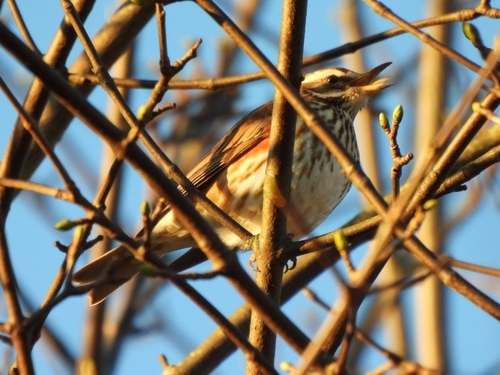
Redwing
Turdus iliacus
The thrush is 20–24 cm long with a wingspan of 33–34.5 cm and a weight of 50–75 g. The sexes are similar, with plain brown backs and with dark brown spots on the white underparts. The most striking identification features are the red flanks and underwing, and the creamy white stripe above the eye. Adults moult between June and September, which means that some start to replace their flight feathers while still feeding young. Voice: The male has a varied short song, and a whistling flight call. Redwings show a distinct dialectic variation in song, having a considerable similarity in song patterns among birds within a local population. The Redwing song consists of a number of introductory elements of descending or ascending frequency.
ID text from Wikipedia, CC BY-SA 4.0

Where you might meet both
And 38 more countries.
Learn this pair in the BeakBrain App
Photo and call practice. Coming soon to iPhone and Android.
Play today's Daily BirdPhotos and recordings are credited to their authors under the licence shown. Full profiles: Common Blackbird and Redwing.