
Clay-colored Thrush
Turdus grayi
In general appearance and habits it resembles other Turdus thrushes such as the American robin. It is about the same length or slightly smaller: 23–27 cm (9.1–10.6 in), and weighs 74–76 g (2.6–2.7 oz) on average. The plumage is brownish, somewhat lighter below than above, lightest on the flanks. Birds from humid regions are darker than those from dry regions. The throat is faintly streaked. Immature birds have faint mottling on the back and underparts. Voice: The song, rather low-pitched and with a slow steady tempo, consists of many slurred musical phrases which are often repeated irregularly. The tock flight call is like the American robin's but harsher. T. grayi's dry season mating call is quite region-specific, with noticeable differences in calls just a few hundred miles apart.
ID text from Wikipedia, CC BY-SA 4.0

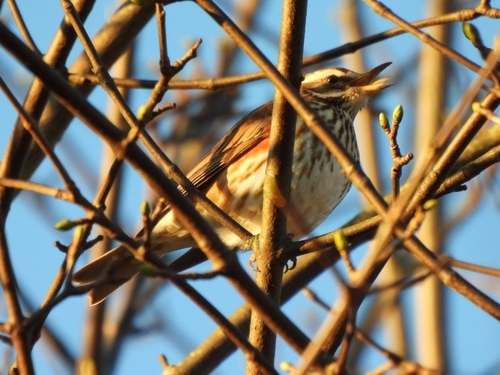
Redwing
Turdus iliacus
The thrush is 20–24 cm long with a wingspan of 33–34.5 cm and a weight of 50–75 g. The sexes are similar, with plain brown backs and with dark brown spots on the white underparts. The most striking identification features are the red flanks and underwing, and the creamy white stripe above the eye. Adults moult between June and September, which means that some start to replace their flight feathers while still feeding young. Voice: The male has a varied short song, and a whistling flight call. Redwings show a distinct dialectic variation in song, having a considerable similarity in song patterns among birds within a local population. The Redwing song consists of a number of introductory elements of descending or ascending frequency.
ID text from Wikipedia, CC BY-SA 4.0

Learn this pair in the BeakBrain App
Photo and call practice. Coming soon to iPhone and Android.
Play today's Daily BirdPhotos and recordings are credited to their authors under the licence shown. Full profiles: Clay-colored Thrush and Redwing.