
Chalk-browed Mockingbird
Mimus saturninus
The chalk-browed mockingbird is 23.5 to 26 cm (9.3 to 10.2 in) long and weighs 55 to 73 g (1.9 to 2.6 oz). Males are slightly larger than females. Adults of the nominate subspecies have a dark brown crown, a broad white supercilium, a blackish line through the eye, and white cheeks. Their upperparts are brownish with some darker streaks; the rump is buffier. Their wings are blackish and show two obscure bars when folded. The tail is also blackish; most feathers have white tips and the outermost have white edges. Voice: The chalk-browed mockingbird's song is loud, a "varied series of notes, trills, phrases". Its calls include a "sharp and penetrating 'tshrip'" and a "snorting sha-sha-sha". It often mimics other species including some raptors.
ID text from Wikipedia, CC BY-SA 4.0

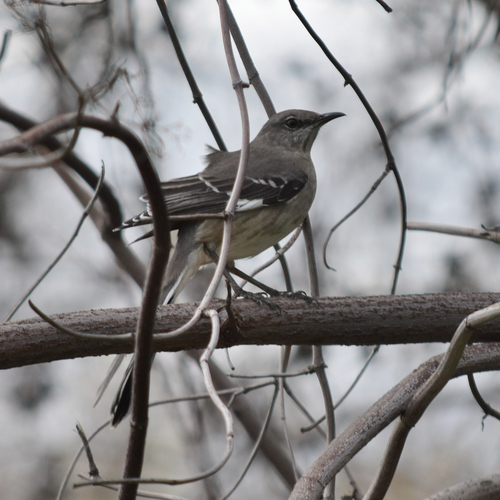
Northern Mockingbird
Mimus polyglottos
The northern mockingbird is a medium-sized mimid that has long legs and tail. Males and females look alike. Its upper parts are colored gray, while its underparts have a white or whitish-gray color. It has parallel wing bars on the half of the wings connected near the white patch giving it a distinctive appearance in flight. The black central rectrices and typical white lateral rectrices are also noticeable in flight. The iris is usually a light green-yellow or a yellow, but there have been instances of an orange color. The bill is black with a brownish black appearance at the base. Voice: Although many species of bird imitate the vocalizations of other birds, the northern mockingbird is the species best known in North America for doing so.
ID text from Wikipedia, CC BY-SA 4.0

Learn this pair in the BeakBrain App
Photo and call practice. Coming soon to iPhone and Android.
Play today's Daily BirdPhotos and recordings are credited to their authors under the licence shown. Full profiles: Chalk-browed Mockingbird and Northern Mockingbird.