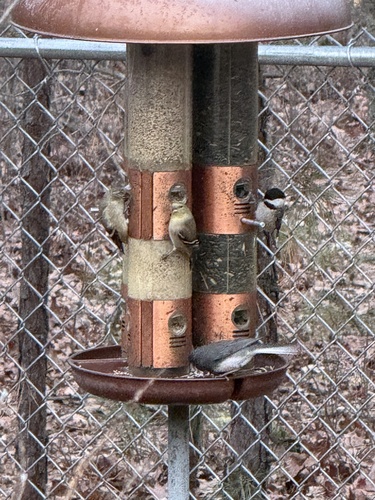
Carolina Chickadee
Poecile carolinensis
Adults are 11.5–13 cm (4.5–5.1 in) long with a weight of 9–12 g (0.32–0.42 oz), and have a black cap and bib with white sides to the face. Their underparts are white with rusty brown on the flanks; their back is gray. They have a short dark bill, short wings and a moderately long tail. Very similar to the black-capped chickadee, the Carolina chickadee is distinguished by the slightly browner wing with the greater coverts brown (not whitish fringed) and the white fringing on the secondary feathers slightly less conspicuous; the tail is also slightly shorter and more square-ended. Voice: The calls and song between the Carolina chickadee and the black-capped chickadee differ subtly to an experienced ear: the Carolina chickadee's chick-a-dee call is faster and higher pitched than that of the black-capped chickadee, and the Carolina chickadee has a four note fee-bee-fee-bay song, whereas the black-capped omits the high notes.
ID text from Wikipedia, CC BY-SA 4.0

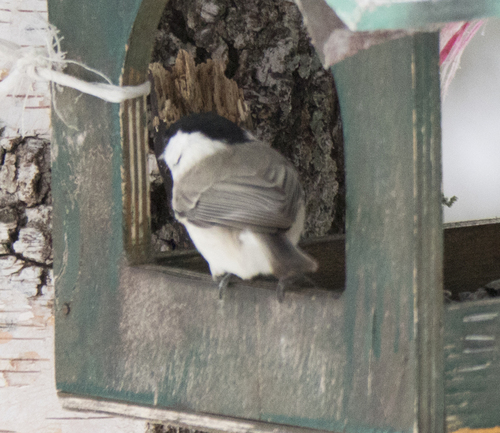
Marsh Tit
Poecile palustris
The nominate subspecies has a black cap and nape with a blue sheen visible at close quarters. The black 'bib' below the bill is rather small; the cheeks are white, turning dusky brown on the ear coverts. The upperparts, tail and wings are greyish-brown, with slightly paler fringes to the tertials. The underparts are off-white with a buff or brown tinge strongest on the flanks and undertail coverts. The bill is black and the legs dark grey.
ID text from Wikipedia, CC BY-SA 4.0

Learn this pair in the BeakBrain App
Photo and call practice. Coming soon to iPhone and Android.
Play today's Daily BirdPhotos and recordings are credited to their authors under the licence shown. Full profiles: Carolina Chickadee and Marsh Tit.