
Cape Sparrow
Passer melanurus
For a sparrow, the Cape sparrow is strikingly coloured and distinctive, and is medium-sized at 14–16 cm (5.5–6.3 in) long. Adults range in weight from 17 to 38 grams (0.60–1.34 oz). The breeding male has a mostly black head, but with a broad white mark on each side, curling from behind the eye to the throat. On the throat a narrow black band connects the black bib of the breast to black of the head. The underparts are greyish, darker on the flanks. The back of the male's neck is dark grey, and its back and shoulders are bright chestnut.
ID text from Wikipedia, CC BY-SA 4.0
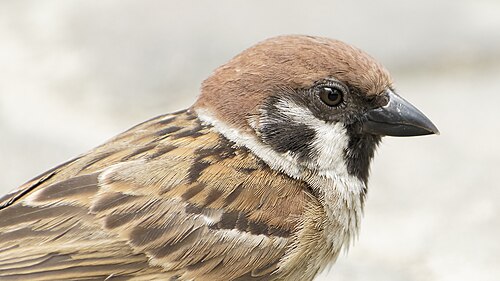
House Sparrow
Passer domesticus
The plumage of the house sparrow is mostly different shades of grey and brown. The sexes exhibit strong dimorphism: the female is mostly buffish above and below, while the male has boldly coloured head markings, a reddish back, and grey underparts. The male has a dark grey crown from the top of its bill to its back, and chestnut brown flanking its crown on the sides of its head. It has black around its bill, on its throat, and on the spaces between its bill and eyes (lores). Voice: Most house sparrow vocalisations are variations on its short and frequent chirping call. Transcribed as chirrup, tschilp, or philip, this note is made as a contact call by flocking or resting birds; or by males to proclaim nest ownership and invite pairing.
ID text from Wikipedia, CC BY-SA 4.0

Where you might meet both
Learn this pair in the BeakBrain App
Photo and call practice. Coming soon to iPhone and Android.
Play today's Daily BirdPhotos and recordings are credited to their authors under the licence shown. Full profiles: Cape Sparrow and House Sparrow.