
Cape Longclaw
Macronyx capensis
The Cape longclaw is a 19–20 cm long. The adult male has a grey head with a buff supercilium and a streaked blackish back. It has a bright orange gorget, black breast band and otherwise yellow underparts. The female is duller, having a yellow throat and much weaker breast band. The juvenile has a dirty yellow throat, indistinct breast band, and yellowish white underparts. The Cape longclaw is usually found in pairs throughout the year. It feeds on the ground on insects and some seeds. The song is a musical cheewit cheewit, the contact call is tsweet, and there is also a mewling alarm call.
ID text from Wikipedia, CC BY-SA 4.0
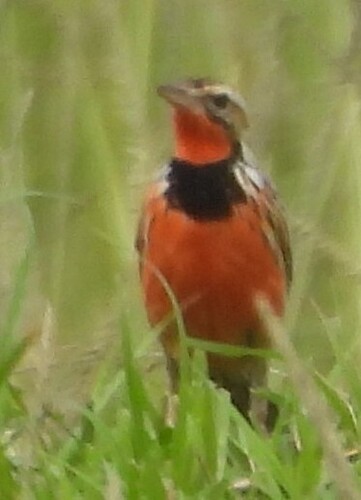
Rosy-throated Longclaw
Macronyx ameliae
Adult birds are 19–20 centimetres (7.5–7.9 in) long with greyish-brown scalloped upper parts. The male has a pink throat and breast crossed with a broad black band across the chest, which is not evident outside of breeding season. Female birds have pink underparts, but lack the black band. Immature birds have mainly black-streaked pale brown underparts with some pink-red colour centrally. It makes a chiteet call, resembling that of a pipit. The rosy-throated longclaw is found in wet grasslands and flood plains, often with lower grasses.
ID text from Wikipedia, CC BY-SA 4.0
Where you might meet both
Learn this pair in the BeakBrain App
Photo and call practice. Coming soon to iPhone and Android.
Play today's Daily BirdPhotos and recordings are credited to their authors under the licence shown. Full profiles: Cape Longclaw and Rosy-throated Longclaw.