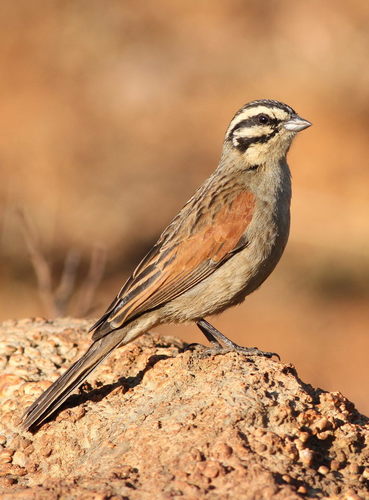
Cape Bunting
Emberiza capensis
The Cape bunting is 16 cm long. The adult has a black crown, white supercilium and black-bordered white ear coverts. The upperparts are grey brown with some dark streaks, and the wing coverts are chestnut. The tail is darker chestnut, and the underparts are grey with a pale throat. The sexes are very similar, but females may have a buff tone to the white head markings. Young birds have duller chestnut wings, a less distinct head pattern, and heavier streaking extending on to the breast and flanks. The call is an ascending zzoo-zeh-zee-zee.
ID text from Wikipedia, CC BY-SA 4.0
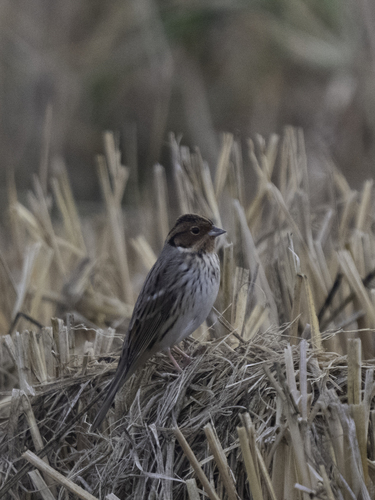
Little Bunting
Emberiza pusilla
This is a small bunting, measuring only 12–14 cm (4.7–5.5 in) in length. It has white underparts with dark streaking on the breast and sides. With its chestnut face and white malar stripe, it resembles a small female reed bunting, but has black crown stripes, a white eye-ring, and a fine dark border to the rear of its chestnut cheeks. The sexes are similar. The call is a distinctive zik, and the song is a rolling siroo-sir-sir-siroo.
ID text from Wikipedia, CC BY-SA 4.0

Learn this pair in the BeakBrain App
Photo and call practice. Coming soon to iPhone and Android.
Play today's Daily BirdPhotos and recordings are credited to their authors under the licence shown. Full profiles: Cape Bunting and Little Bunting.