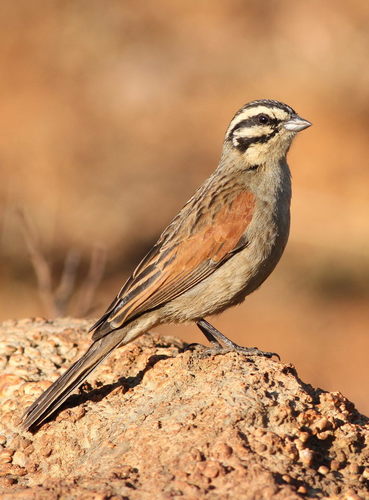
Cape Bunting
Emberiza capensis
The Cape bunting is 16 cm long. The adult has a black crown, white supercilium and black-bordered white ear coverts. The upperparts are grey brown with some dark streaks, and the wing coverts are chestnut. The tail is darker chestnut, and the underparts are grey with a pale throat. The sexes are very similar, but females may have a buff tone to the white head markings. Young birds have duller chestnut wings, a less distinct head pattern, and heavier streaking extending on to the breast and flanks. The call is an ascending zzoo-zeh-zee-zee.
ID text from Wikipedia, CC BY-SA 4.0
Cinnamon-breasted Bunting
Emberiza tahapisi
They weigh between 11.6 and 21 grams with a length of 13–15 centimeters. Although plumage differs between juveniles, males, and females, cinnamon-breasted buntings can be identified by their striped head and cinnamon brown underparts. Males have black and white stripes whereas the female stripes are less dark and browner in color. The throat patch is uniformly black on males but smaller, grayish, and densely blotched on females. Juveniles are similar to females but with buffier head stripes and a paler, browner throat.
ID text from Wikipedia, CC BY-SA 4.0

Where you might meet both
Learn this pair in the BeakBrain App
Photo and call practice. Coming soon to iPhone and Android.
Play today's Daily BirdPhotos and recordings are credited to their authors under the licence shown. Full profiles: Cape Bunting and Cinnamon-breasted Bunting.