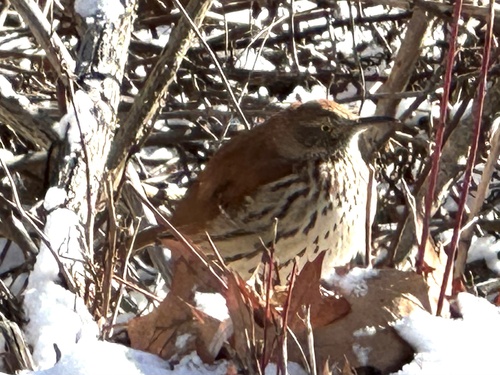
Brown Thrasher
Toxostoma rufum
The brown thrasher is bright reddish-brown above with thin, dark streaks on its buffy underparts. It has a whitish-colored chest with distinguished teardrop-shaped markings on its chest. Its long, rufous tail is rounded with paler corners, and eyes are a brilliant yellow. Its bill is brownish, long, and curves downward. Both male and females are similar in appearance. The juvenile appearance of the brown thrasher from the adult is not remarkably different, except for plumage texture, indiscreet upper part markings, and the irises having an olive color.
ID text from Wikipedia, CC BY-SA 4.0

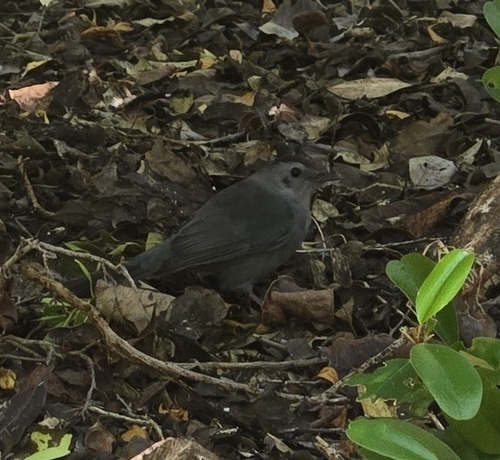
Grey Catbird
Dumetella carolinensis
Adults weigh from 23.2 to 56.5 g (0.8 to 2.0 oz), with an average of 35–40 g (1.2–1.4 oz) They range in length from 20.5 to 24 cm (8.1 to 9.4 in) and span 22 to 30 cm (8.7 to 11.8 in) across the wings. Among standard measurements, the wing chord is 8.4 to 9.8 cm (3.3 to 3.9 in), the tail is 7.2 to 10.3 cm (2.8 to 4.1 in), the culmen is 1.5 to 1.8 cm (0.6 to 0.7 in) and the tarsus is 2.7 to 2.9 cm (1.1 to 1.1 in). Gray catbirds are plain lead gray almost all over. The top of the head is darker. Voice: This species is named for its cat-like call. Like many members of the Mimidae (in particular mockingbirds), it also mimics the songs of other birds, as well as those of Hylidae (tree frogs), and even mechanical sounds. Because of its well-developed songbird syrinx, it is able to make two sounds at the same time. The alarm call resembles the quiet calls of a male mallard.
ID text from Wikipedia, CC BY-SA 4.0

Where you might meet both
Learn this pair in the BeakBrain App
Photo and call practice. Coming soon to iPhone and Android.
Play today's Daily BirdPhotos and recordings are credited to their authors under the licence shown. Full profiles: Brown Thrasher and Grey Catbird.