
Brown Rock Chat
Oenanthe fusca
The brown rock chat is about 17 cm long, larger than the somewhat similar-looking Indian robin. It is uniformly rufous brown with the wings and tail of a slightly darker shade. The brown on the undersides grades into a dark grey-brown vent. The beak is slender and is slightly curved at the tip. The second primary is the longest and the tail is rounded. In flight it resembles a female blue rock thrush. The sexes are indistinguishable in the field. Voice: Brown rock chats have a wide repertoire of calls. Nearly eight different kinds of calls have been noted, including territorial calls, begging calls, feeding calls, alarm calls, threat calls, contact calls, distress calls, roosting calls and emergence calls. The most common call is a short whistled chee delivered with a rapid bob and stretch, and the alarm call is a harsh chek-check.
ID text from Wikipedia, CC BY-SA 4.0
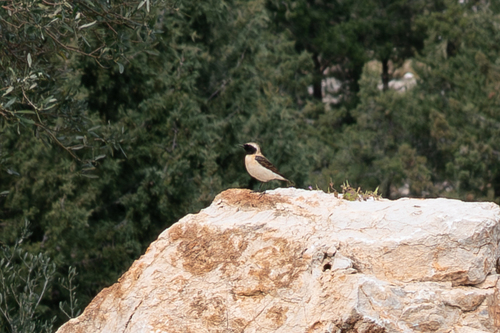
Western Black-eared Wheatear
Oenanthe hispanica
The breeding male has the forehead and crown white or nearly white, the mantle buff, and the wings blacker than those of the northern wheatear. The underparts are white tinged with buff. The back, upper tail coverts and most of the tail are white. A black mask extends from the ear coverts to the bill. The throat can be either black or white. In autumn and winter the head and mantle are distinctly buff, as are the underparts (including the throat in non-black-throated individuals), but the buff varies in intensity.
ID text from Wikipedia, CC BY-SA 4.0
Learn this pair in the BeakBrain App
Photo and call practice. Coming soon to iPhone and Android.
Play today's Daily BirdPhotos and recordings are credited to their authors under the licence shown. Full profiles: Brown Rock Chat and Western Black-eared Wheatear.