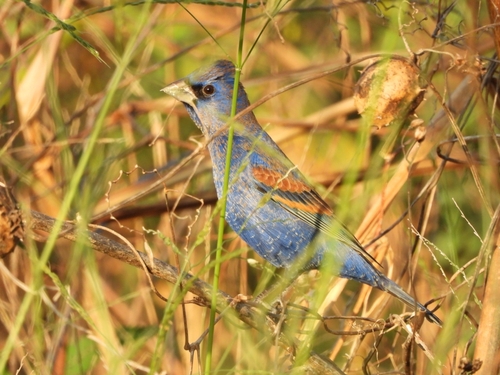
Blue Grosbeak
Passerina caerulea
The male blue grosbeak is deep blue, with both black and brown on its wings. The female is mostly brown. Both sexes are distinguished by their large, deep bill and double wing bars. These features, as well as the grosbeak's relatively larger size, distinguish this species from the indigo bunting. Length can range from 14 to 19 cm (5.5 to 7.5 in) and wingspan is from 26 to 29 cm (10 to 11 in). Body mass is typically from 26 to 31.5 g (0.92 to 1.11 oz).
ID text from Wikipedia, CC BY-SA 4.0


Lazuli Bunting
Passerina amoena
Measurements: Length: 5.1–5.9 in (13–15 cm) Weight: 0.5–0.6 oz (13–18 g) Wingspan: 8.7 in (22 cm) The male is easily recognized by its bright blue head and back (lighter than the closely related indigo bunting), its conspicuous white wingbars, and its light rusty breast and white belly. The color pattern may suggest the eastern and western bluebirds, but the smaller size (13–15 cm or 5–5.9 inches long), wingbars, and short and conical bunting bill quickly distinguish it. Voice: The song is a high, rapid, strident warble, similar to that of the indigo bunting but longer and with less repetition.
ID text from Wikipedia, CC BY-SA 4.0

Where you might meet both
Learn this pair in the BeakBrain App
Photo and call practice. Coming soon to iPhone and Android.
Play today's Daily BirdPhotos and recordings are credited to their authors under the licence shown. Full profiles: Blue Grosbeak and Lazuli Bunting.