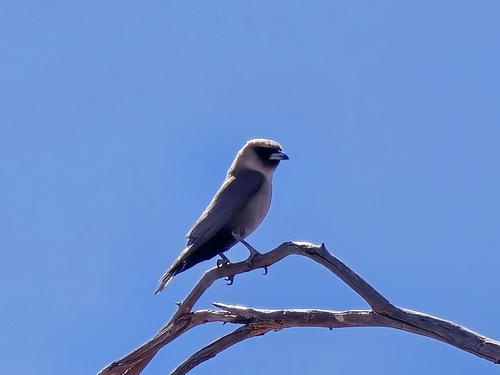
Black-faced Woodswallow
Artamus cinereus
The black-faced woodswallow is 18–19 cm (7.1–7.5 in) in length, and weighs 32–40 g (1.1–1.4 oz). It has a blue-grey beak with a black tip and a black face mask which extends from the base of the bill up to and around the eyes. It has ash grey plumage, which is lighter around the breast with darker wings, and silver underwings. The tail is black with a white tip. The subspecies are differentiated by black or white colouration of their tail vents. The white-vented subspecies A. c. normani and A. c. inkermani are found on the Cape York Peninsula and northern Queensland respectively.
ID text from Wikipedia, CC BY-SA 4.0

White-breasted Woodswallow
Artamus leucorynchus
The white-breasted woodswallow's plumage is dark grey on the head and neck, with white underparts, giving the species its common and scientific names, in contrast to the related great woodswallow whose upper side is a more glossy black. The stout bill is bluish-grey with a black tip. They can also be identified by their short, black tail and grey feet. Their completely black tail makes them the only woodswallow lacking white on the tail. Males and females are identical in appearance. Juveniles have a more brownish plumage around their head and mantle that is usually heavily striated.
ID text from Wikipedia, CC BY-SA 4.0
Where you might meet both
Learn this pair in the BeakBrain App
Photo and call practice. Coming soon to iPhone and Android.
Play today's Daily BirdPhotos and recordings are credited to their authors under the licence shown. Full profiles: Black-faced Woodswallow and White-breasted Woodswallow.