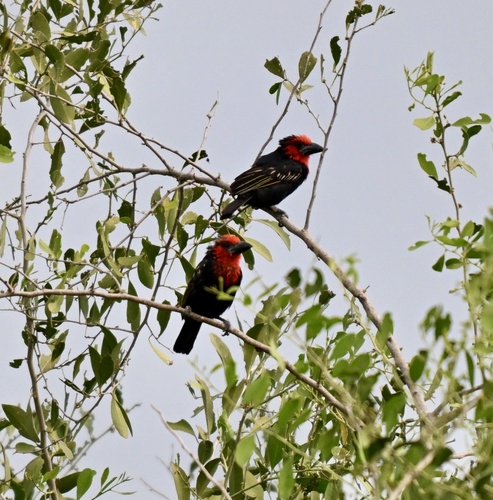
Black-billed Barbet
Lybius guifsobalito
Lybius guifsobalito can reach a wingspan of 7.9–9.4 cm (3.1–3.7 in) in males. The tail length is between 4.5 and 5.4 centimeters. The beak reaches a length between 1.9 and 2.2 centimeters. Females have similar body measurements, without noticeable sexual dimorphism. Males and femalesof these medium-sized barbets are glossy blue-black, the wings and the belly are a little more brown. They also have a bright red or red-orange face, throat and upper chest. The upperwing are narrowly lined with yellow to white.
ID text from Wikipedia, CC BY-SA 4.0
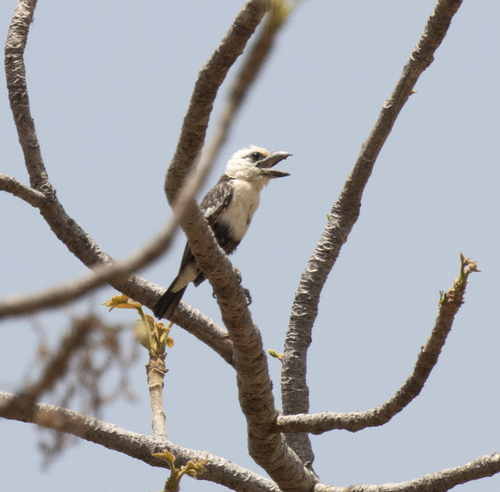
White-headed Barbet
Lybius leucocephalus
This species is one of the largest in this genus at 18–19.5 cm (7.1–7.7 in) in length. It is a black and white type of barbet that has a stubby neck and a heavy-toothed bill. It is found in open woodland areas that are close to water and cultivation. It utilizes fig and jacaranda trees to find food and to excavate nests. These birds are also very social and live in small groups.
ID text from Wikipedia, CC BY-SA 4.0

Where you might meet both
Learn this pair in the BeakBrain App
Photo and call practice. Coming soon to iPhone and Android.
Play today's Daily BirdPhotos and recordings are credited to their authors under the licence shown. Full profiles: Black-billed Barbet and White-headed Barbet.