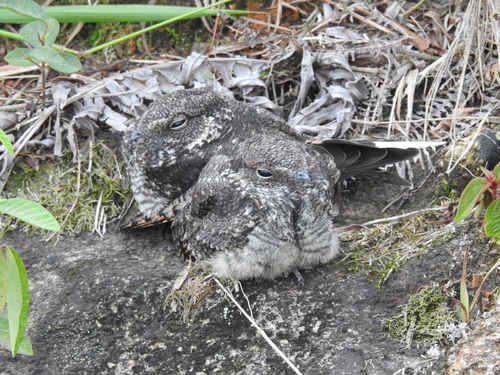
Band-winged Nightjar
Systellura longirostris
Over its large range, there are significant variations in its morphology, but, as suggested by its common name, it always has a distinctive band in the wing (best visible in flight), which is white in the male and buff in the female. This nightjar has a length that varies from 20 to 27 cm (for Ecuador, 21.5 to 23 cm). The iris, bill, legs, and feet vary from brown to blackish brown. On the upper side, a greyish-brown, blackish-brown, brownish-orange, pale yellowish-brown, and greyish-white coloration can be distinguished. The rear of the neck is from a brownish orange to a yellowish brown. Voice: The species has a variety of calls. The territorial tone is a high-sharp whistle, seeeeert sweeeert seeeet, constantly repeated every 1 to 3 seconds. Whistles can be heard at dusk or dawn. The flight whistle is usually heard during the breeding season as a high cheet. Females when flushed produce a nasal sound like tchree-ee.
ID text from Wikipedia, CC BY-SA 4.0


Jerdon's Nightjar
Caprimulgus atripennis
Like other nightjars, it has a wide gape, long wings, soft downy plumage and nocturnal habits. At 26 cm in overall length, it is almost a head's length larger than the Indian nightjar (C. asiaticus), and differs from that species in its barred tail, rufous rear neck, and wing bars. The vermiculations on the crown are fine giving it a nearly uniform shade. The collar is blackish. The male has a white patch on each wing. Otherwise, their cryptic plumage is mainly variegated buff and brown, as typical for the dark tropical woodland nightjars.
ID text from Wikipedia, CC BY-SA 4.0

Learn this pair in the BeakBrain App
Photo and call practice. Coming soon to iPhone and Android.
Play today's Daily BirdPhotos and recordings are credited to their authors under the licence shown. Full profiles: Band-winged Nightjar and Jerdon's Nightjar.