
Azores Chaffinch
Fringilla moreletti
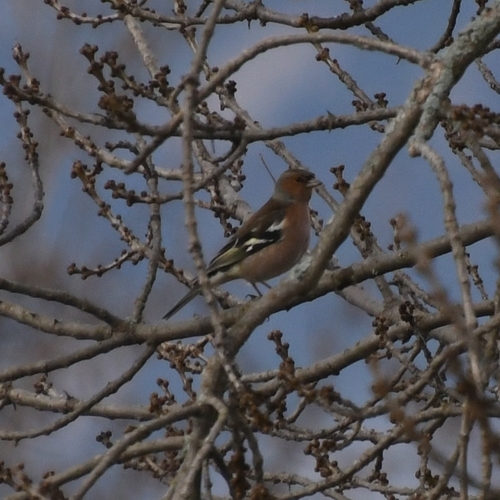
The top and rear of the head and part of the mantle are bluish-grey, with the rest of the mantle being greenish; the wings and tail are black and white; the throat, cheeks, and chest are pink. Unlike other chaffinches, it often shows a pale supercilium above and behind the eye. The bill is grey with a dark tip and cutting edges. The legs and feet are dark pinkish-brown. The plumage of the females is duller, brown above and paler brown below, and with narrower white wing and tail markings.
ID text from Wikipedia, CC BY-SA 4.0
Eurasian Chaffinch
Fringilla coelebs
The Eurasian chaffinch is about 14.5 cm (5.7 in) long, with a wingspan of 24.5–28.5 cm (9.6–11.2 in) and a weight of 18–29 g (0.63–1.02 oz). The adult male of the nominate subspecies has a black forehead and a blue-grey crown, nape and upper mantle. The rump is a light olive-green; the lower mantle and scapulars form a brown saddle. The side of head, throat and breast are a dull rust-red merging to a pale creamy-pink on the belly. The central pair of tail feathers are dark grey with a black shaft streak. Voice: Songs Males typically sing two or three different song types, and there are regional dialects also. The acquisition by the young Eurasian chaffinch of its song was the subject of an influential study by British ethologist William Thorpe.
ID text from Wikipedia, CC BY-SA 4.0

Where you might meet both
Learn this pair in the BeakBrain App
Photo and call practice. Coming soon to iPhone and Android.
Play today's Daily BirdPhotos and recordings are credited to their authors under the licence shown. Full profiles: Azores Chaffinch and Eurasian Chaffinch.