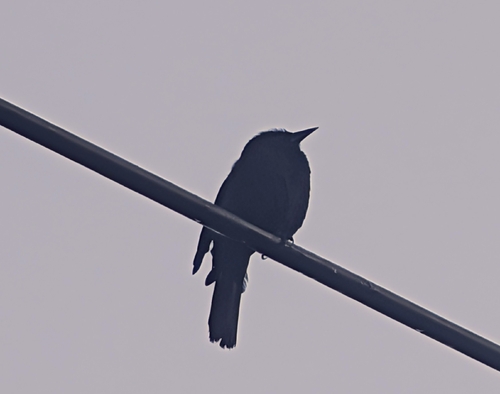
Austral Blackbird
Curaeus curaeus
Its plumage is entirely black with a slight bluish hint, and its physical features consist of black legs, black eyes, and a sharp beak with missing pigmentation in the head, chest, and wings. Compared to other birds in its family, the Austral Blackbird has a highly varied voice, and they do a lot of singing and calling together.
ID text from Wikipedia, CC BY-SA 4.0
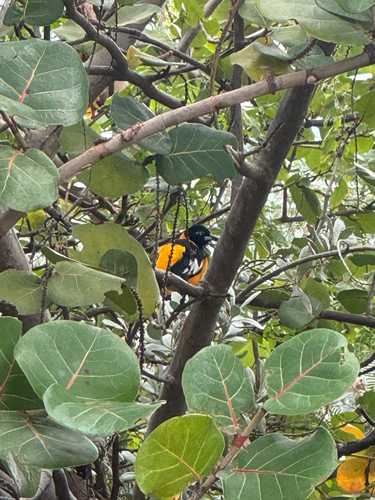
Venezuelan Troupial
Icterus icterus
Venezuelan troupials are fairly large in size, with a long tail and a bulky bill. It has a black head and upper breast. The feathers on the front of the neck and upper breast stick outward, making an uneven boundary between the black and the orange of the bird's lower breast and underside. The rest of the orange color is found on the upper and lower back, separated by the black shoulders. The wings are mostly black except for a white streak that runs the length of the wing when in a closed position. The eyes are yellow, and surrounding each one, there is a patch of bright, blue, naked skin.
ID text from Wikipedia, CC BY-SA 4.0
Where you might meet both
Learn this pair in the BeakBrain App
Photo and call practice. Coming soon to iPhone and Android.
Play today's Daily BirdPhotos and recordings are credited to their authors under the licence shown. Full profiles: Austral Blackbird and Venezuelan Troupial.