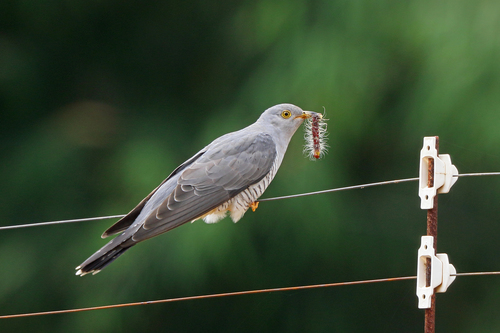
African Cuckoo
Cuculus gularis
This is a medium-sized species with a long tail, with a total length of 32 cm (13 in). Its dashing flight makes it resemble a bird of prey. The sexes are similar, the head, upper parts and wings being dark grey, the throat and breast pale grey and the belly white barred with dark grey. The tail is dark grey with dark barring and a white tip. The eye is yellow in the male and light brown in the female. The beak is yellow, tipped with black or horn. The legs and feet are yellowish.
ID text from Wikipedia, CC BY-SA 4.0


Himalayan Cuckoo
Cuculus saturatus
Adult male Himalayan cuckoos are dark ashy-grey above with a brown, almost black, tail that is whitely spotted and tipped. Legs and feet range between yellow and orange. The area from their chins to the breast is ash-grey, with their lower breast and abdomen being white with black bars, and a white to milky orange vent with varying bars. The eye-ring is yellow with yellow to brown irises—darker orange has been seen in males. Bills are black with an orange-yellow or green-yellow base. Their size approximately 30–35 cm and 70–140 g. Voice: Males are notably recorded more during dawn and dusk from high lookouts or in flight. Their call includes a high note followed by three lower flat notes, similar to "hoop, hoop-hoop" or "tun-tadun", much like that of a Common Hoopoe (Upupa epops) but lower-pitched and more muffled. The males also produce hoarse croaking sounds and chuckles, even a harsh "gaak-gaak-gak-ak-ak-ak" at times.
ID text from Wikipedia, CC BY-SA 4.0
Learn this pair in the BeakBrain App
Photo and call practice. Coming soon to iPhone and Android.
Play today's Daily BirdPhotos and recordings are credited to their authors under the licence shown. Full profiles: African Cuckoo and Himalayan Cuckoo.