Learn what every symbol on the card means.Full credits and sources at beakbrain.com/symbols
 ForestCup nestSmall · 59 g


ID tip
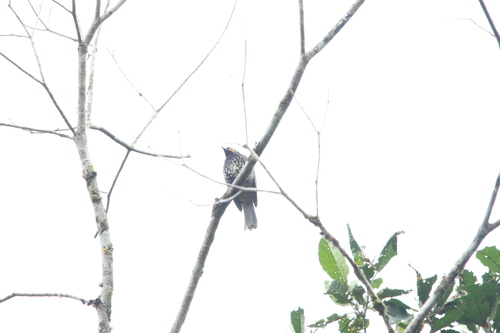
The common smoky honeyeater has a bright orange splotch around both eyes. The bird's upper wing has brown tips, olive-colored edges, and a lighter shade of brown on the base of its wings. This bird has a brown and black base. The common smoky honeyeater has a brown belly with white crescent-shaped scaling and gray and brown legs. The best way to differentiate between males and females is to look at their size because male common smoky honeyeaters tend to be bigger than females. Voice: The common smoky honeyeater makes a "sit-sit-sit" or a faint "swift-swift-swift" sound. When it is near the young, it makes a "wheat-wheat-wheat" to alarm other common smoky honeyeaters.
Text from Wikipedia, licensed CC BY-SA 4.0.
When to see the Common Smoky Honeyeater
One bar for each month. Filled bars are the 5 months with records; pale bars are months with none. The wide bar is July, the month with the most records.
Where to see the Common Smoky Honeyeater
The map shades 2 countries with regular records. Everything unshaded has no records. Countries are listed below the map.
About the Common Smoky Honeyeater
The common smoky honeyeater is a medium-sized bird found in central Papua New Guinea and Eastern Indonesia. It is one of four species in the Melipotes genus. The common smoky honeyeater can be identified by its charcoal-colored body and blotchy neon orange circle around its eyes.. Its diet consists of small fruits, insects, and floral plants. This bird breeds in September and October, which are considered relatively dry months, above ground or next to a tree branch.
Text adapted from Wikipedia, licensed CC BY-SA 4.0.
Easily confused with
 Arfak HoneyeaterMelipotes gymnopsThe Arfak honeyeater or bare-eyed honeyeater, is a species of bird in the family Meliphagidae.
Spangled HoneyeaterMelipotes aterThe spangled honeyeater is a species of bird in the family Meliphagidae.
Wattled Smoky HoneyeaterMelipotes carolaeThe wattled smoky honeyeater or Foja honeyeater is a species of honeyeater with a sooty-grey plumage and a black bill.
Arfak HoneyeaterMelipotes gymnopsThe Arfak honeyeater or bare-eyed honeyeater, is a species of bird in the family Meliphagidae.
Spangled HoneyeaterMelipotes aterThe spangled honeyeater is a species of bird in the family Meliphagidae.
Wattled Smoky HoneyeaterMelipotes carolaeThe wattled smoky honeyeater or Foja honeyeater is a species of honeyeater with a sooty-grey plumage and a black bill.
Learn the Common Smoky Honeyeater in the BeakBrain App
Photo and call practice. Coming soon to iPhone and Android.
Play today's Daily BirdEvery photo and recording on this page is credited to its author under the licence shown. Spotted a problem with this page, or have a better photo? Contribute.