Learn what every symbol on the card means.Full credits and sources at beakbrain.com/symbols
 WetlandPlatform nestHuge · 5.0 kg




What the Common Loon sounds like


ID tip
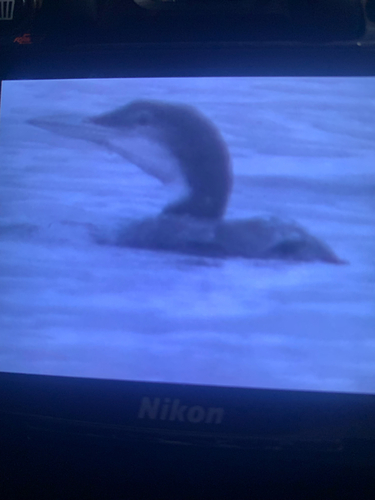
The adult common loon can range from 66 to 91 cm (26 to 36 in) in length with a 127 to 147 cm (4 ft 2 in to 4 ft 10 in) wingspan, slightly smaller than the similar yellow-billed loon. On average, it is about 81 cm (32 in) long and has a wingspan of 136 cm (54 in). Its weight can vary anywhere from 2.2 to 7.6 kg (4.9 to 16.8 lb). Sizes vary regionally, especially by body mass, with the smallest bodied loons on average from lower-central Canada and the Great Lakes, while westerly birds are similar or mildly larger, and loons breeding further east can appear to be significantly larger. Voice: The common loon produces a variety of vocalizations, the most common of which are the tremolo, the yodel, the wail, and the hoot. Each of these calls communicates a distinct message. The frequency at which it vocalizes has been shown to vary based on time of day, weather, and season. It is most vocally active between mid-May and mid-June.
Text from Wikipedia, licensed CC BY-SA 4.0.
When to see the Common Loon
One bar for each month, and every month is filled: this bird is recorded here in all twelve. The wide bar is April, the month with the most records.
Where to see the Common Loon
The map shades 33 countries with regular records, and 6 more in a lighter tone where the bird turns up only as a stray. Everything unshaded has no records. Countries are listed below the map.
Recorded as a rare visitor in Finland, Luxembourg, Morocco, Ukraine, Namibia, Cuba.
About the Common Loon
The common loon or great northern diver is a large member of the loon, or diver, family of birds. Breeding adults have a plumage that includes a broad black head and neck with a greenish, purplish, or bluish sheen, blackish or blackish-grey upperparts, and pure white underparts except some black on the undertail coverts and vent. Non-breeding adults are brownish with a dark neck and head marked with dark grey-brown. Their upperparts are dark brownish-grey with an unclear pattern of squares on the shoulders, and the underparts, lower face, chin, and throat are whitish. The sexes look alike, though males are significantly heavier than females.
Text adapted from Wikipedia, licensed CC BY-SA 4.0.
Easily confused with
 Red-throated LoonGavia stellataLike the other members of its genus, the red-throated loon is well adapted to its aquatic environment: its dense bones help it to submerge, its legs—in their set-back position—provide excellent propulsion, and its body is long and streamlined.
 Black-throated LoonGavia arcticaThe adult black-throated loon is 58 to 73 cm (23 to 29 in) in length with a 100 to 130 cm (39 to 51 in) wingspan and a weight of 1.3 to 3.4 kilograms (2.9 to 7.5 lb).
 Pacific LoonGavia pacificaBreeding adults are like a smaller sleeker version of common loon.
Side by side: Common Loon vs Red-throated Loon · Black-throated Loon vs Common Loon · Common Loon vs Pacific Loon
Learn the Common Loon in the BeakBrain App
Photo and call practice. Coming soon to iPhone and Android.
Play today's Daily BirdEvery photo and recording on this page is credited to its author under the licence shown. Spotted a problem with this page, or have a better photo? Contribute.