Learn what every symbol on the card means.Full credits and sources at beakbrain.com/symbols
 WetlandPlatform nestMedium · 99 g




ID tip
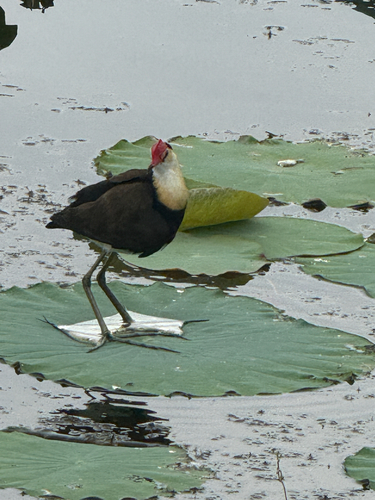
This species is unmistakable. It has a black crown and hindneck with a fleshy red wattle covering the forehead and forecrown, contrasting with a white face and throat. The comb is pinker in breeding adults, more orange when not breeding. There is a broad black band on the lower breast with white belly. The underwing and flight feathers, which show most prominently in flight, are black. Back and upperwing mainly grey-brown with black primary coverts, rump and tail. The long legs with extremely long toes trail in flight. The male is slightly smaller than the female and measures 20–22 cm (7.9–8. Voice: This species gives a squeaky, high-pitched chittering, also described as a shrill trill with an explosive soft bugle.
Text from Wikipedia, licensed CC BY-SA 4.0.
When to see the Comb-crested Jacana
One bar for each month, and every month is filled: this bird is recorded here in all twelve. The wide bar is October, the month with the most records.
Where to see the Comb-crested Jacana
The map shades 5 countries with regular records. Everything unshaded has no records. Countries are listed below the map.
About the Comb-crested Jacana
The comb-crested jacana, also known as the lotusbird or lilytrotter, is the only species of jacana in the genus Irediparra. Like other jacana species, it is adapted to the floating vegetation of tropical freshwater wetlands.
Text adapted from Wikipedia, licensed CC BY-SA 4.0.
Easily confused with
 Pheasant-tailed JacanaHydrophasianus chirurgusThe pheasant-tailed jacana is conspicuous and unmistakable.
 African JacanaActophilornis africanusThe African jacana is a conspicuous and unmistakable bird.
 Lesser JacanaMicroparra capensisThe smallest species in the Jacanidae family, the lesser jacana is 15–16 cm tall and weighs 41g.
Side by side: Comb-crested Jacana vs Pheasant-tailed Jacana · African Jacana vs Comb-crested Jacana · Comb-crested Jacana vs Lesser Jacana
Learn the Comb-crested Jacana in the BeakBrain App
Photo and call practice. Coming soon to iPhone and Android.
Play today's Daily BirdEvery photo and recording on this page is credited to its author under the licence shown. Spotted a problem with this page, or have a better photo? Contribute.