Learn what every symbol on the card means.Full credits and sources at beakbrain.com/symbols
 ForestCup nestTiny · 7 g


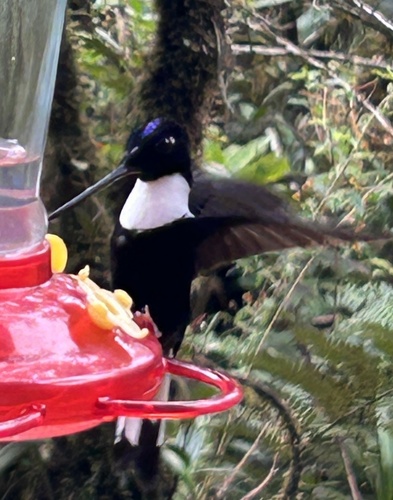
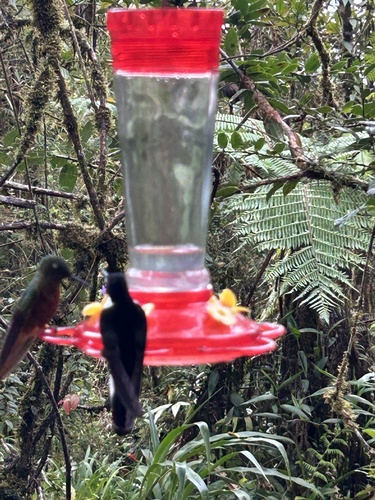

ID tip
10–14 centimetres (3.9–5.5 in) in length, with a rather long (3–3.5 centimetres (1.2–1.4 in)), straight, black beak. Under most lighting conditions Coeligena torquata torquata appears black except for a very large and distinctive white chest-patch. However, in ideal lighting other features can be discerned: a shimmering metallic violet forehead patch in males, white thighs, fleshy-dusky feet, shimmering green throat in males, dull and containing some white in females, and some dark green mixed in with the black of the body.
Text from Wikipedia, licensed CC BY-SA 4.0.
When to see the Collared Inca
One bar for each month, and every month is filled: this bird is recorded here in all twelve. The wide bar is November, the month with the most records.
Where to see the Collared Inca
The map shades 5 countries with regular records. Everything unshaded has no records. Countries are listed below the map.
About the Collared Inca
The collared inca is a species of hummingbird found in humid Andean forests from western Venezuela through Colombia and Ecuador to Peru. It is very distinctive in having a white chest-patch and white on the tail. Like other hummingbirds it takes energy from flower nectar, while the plant benefits from the symbiotic relationship by being pollinated. Its protein source is small arthropods such as insects. It is normally solitary and can be found at varying heights above the ground, often in the open.
Text adapted from Wikipedia, licensed CC BY-SA 4.0.
Easily confused with
 Bronzy IncaCoeligena coeligenaThe bronzy inca is about 14 cm (5.5 in) long.
 Brown IncaCoeligena wilsoniThe brown inca is about 11 to 13 cm (4.3 to 5.1 in) long.
 Buff-winged StarfrontletCoeligena lutetiaeThe buff-winged starfrontlet is about 14 cm (5.5 in) long.
Side by side: Bronzy Inca vs Collared Inca · Brown Inca vs Collared Inca · Buff-winged Starfrontlet vs Collared Inca
Learn the Collared Inca in the BeakBrain App
Photo and call practice. Coming soon to iPhone and Android.
Play today's Daily BirdEvery photo and recording on this page is credited to its author under the licence shown. Spotted a problem with this page, or have a better photo? Contribute.