Learn what every symbol on the card means.Full credits and sources at beakbrain.com/symbols
 GrasslandDomed nestSmall · 23 g


ID tip
The male is slaty brown above with a white forehead and supercilium. The wings are brownish and the tail is blackish with white base and tips. The sides of the throat and breast are black and the centre of the chin and throat is scarlet. Each of the black feathers on the breast is narrowly fringed with grey. The belly and vent are white. The female is dull, brownish grey above with a diffuse supercilium and smoky underparts. The centre of the throat is whitish as is the short moustachial stripe.
Text from Wikipedia, licensed CC BY-SA 4.0.
When to see the Chinese Rubythroat
One bar for each month. Filled bars are the 11 months with records; pale bars are months with none. The wide bar is March, the month with the most records.
Where to see the Chinese Rubythroat
The map shades 4 countries with regular records, and 2 more in a lighter tone where the bird turns up only as a stray. Everything unshaded has no records. Countries are listed below the map.
About the Chinese Rubythroat
The Chinese rubythroat is a small passerine bird in the family Muscicapidae. It is closely related to the Siberian rubythroat which however lacks the distinctive white tail-tips and white tail bases. It was also previously considered conspecific with the Himalayan rubythroat, together called the white-tailed rubythroat. It is found along the Himalayan ranges from Pakistan to Myanmar.
Text adapted from Wikipedia, licensed CC BY-SA 4.0.
Easily confused with
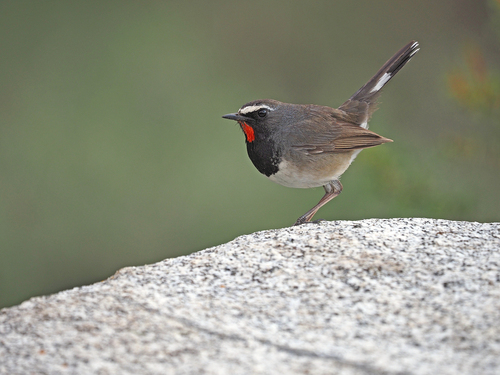 Himalayan RubythroatCalliope pectoralisThe male is slaty brown above with a white forehead and supercilium.
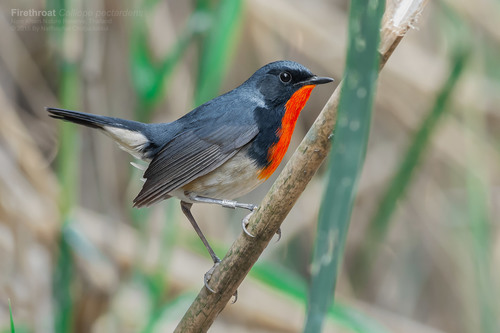 FirethroatCalliope pectardensThe firethroat also known as David's rubythroat or Père David's orangethroat is a species of passerine bird in the family Muscicapidae, found in western and central parts of China.
 BlackthroatCalliope obscuraThe blackthroat, also known as the black-throated robin or black-throated blue robin, is a species of bird in the family Muscicapidae.
Learn the Chinese Rubythroat in the BeakBrain App
Photo and call practice. Coming soon to iPhone and Android.
Play today's Daily BirdEvery photo and recording on this page is credited to its author under the licence shown. Spotted a problem with this page, or have a better photo? Contribute.