Learn what every symbol on the card means.Full credits and sources at beakbrain.com/symbols
 WetlandDomed nestTiny · 12 g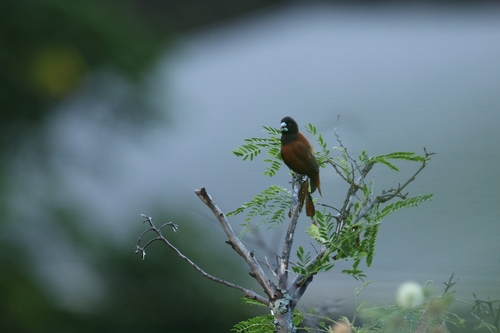


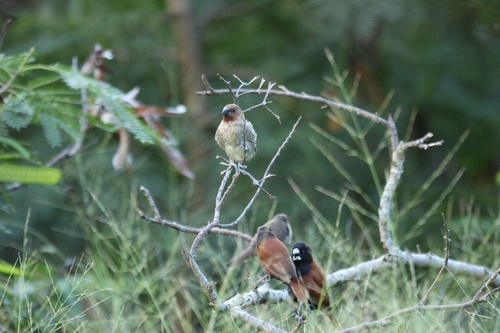
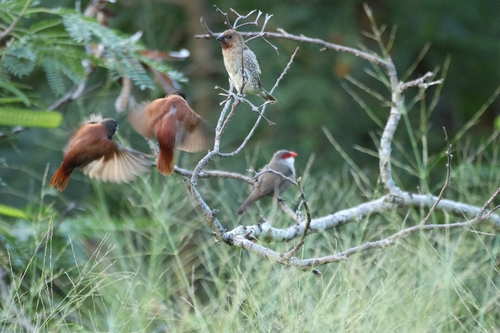
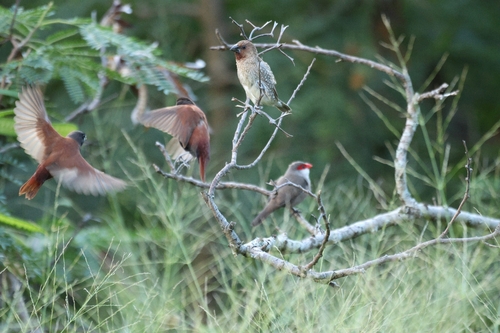
ID tip
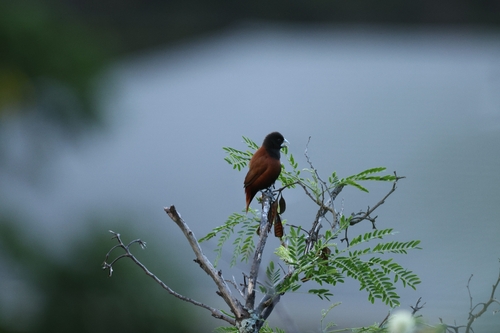
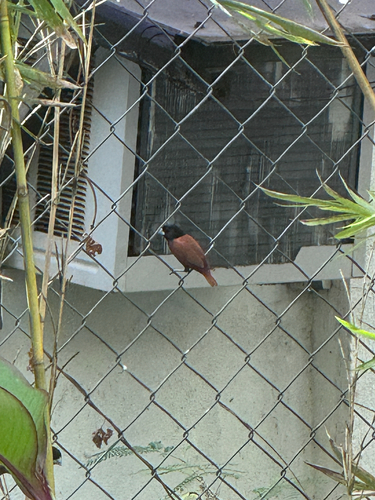
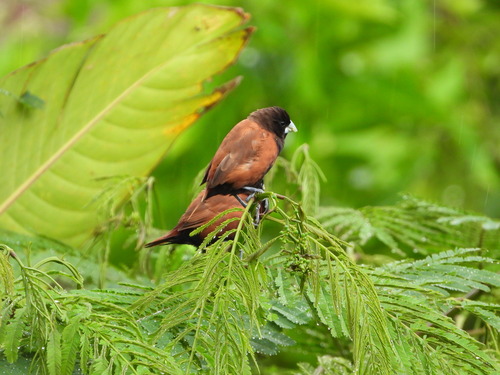
Small, sexes alike, races differ slightly in intensity of colour. In L. a. jagori, the adult has the whole head, breast, centre of belly, and undertail coverts black; the back, wing, and sides of belly chestnut, brighter on underparts, duller on wings; uppertail coverts dark reddish brown, underpart buff; uppertail coverts and tail as adult. Bill silvery grey; eye chestnut; legs gray.
Text from Wikipedia, licensed CC BY-SA 4.0.
When to see the Chestnut Munia
One bar for each month, and every month is filled: this bird is recorded here in all twelve. The wide bar is March, the month with the most records.
Where to see the Chestnut Munia
The map shades 24 countries with regular records, and 4 more in a lighter tone where the bird turns up only as a stray. Everything unshaded has no records. Countries are listed below the map.
Recorded as a rare visitor in Portugal, Ecuador, Trinidad & Tobago, Guam.
About the Chestnut Munia
The chestnut munia or black-headed munia is a small passerine. It was formerly considered conspecific with the closely related tricoloured munia, but is now widely accepted as a separate species. This estrildid finch is a resident breeding bird in Bangladesh, Brunei, Cambodia, China, India, Indonesia, Laos, Malaysia, Burma, Nepal, the Philippines, Singapore, Taiwan, Thailand, Vietnam and Hawaii. It also has been introduced to all the Greater Antilles and Martinique in the Caribbean.
Text adapted from Wikipedia, licensed CC BY-SA 4.0.
Easily confused with
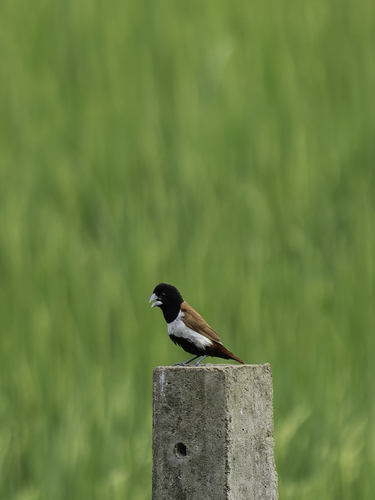 Tricolored MuniaLonchura malaccaThe tricoloured munia is an estrildid finch, native to Bangladesh, India, Sri Lanka, Pakistan, and southern China.
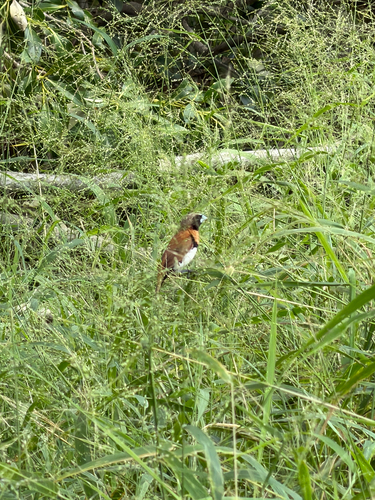 Chestnut-breasted MannikinLonchura castaneothoraxThe chestnut-breasted mannikin, also known as the chestnut-breasted munia or bully bird, is a small brown-backed munia with a black face and greyish crown and nape.
 Black-throated MuniaLonchura kelaartiThe black-throated munia or Jerdon's mannikin is a small passerine bird.
Side by side: Chestnut Munia vs Scaly-breasted Munia · Chestnut Munia vs White-rumped Munia
Learn the Chestnut Munia in the BeakBrain App
Photo and call practice. Coming soon to iPhone and Android.
Play today's Daily BirdEvery photo and recording on this page is credited to its author under the licence shown. Spotted a problem with this page, or have a better photo? Contribute.