Learn what every symbol on the card means.Full credits and sources at beakbrain.com/symbols
 ForestCup nest62 g


ID tip
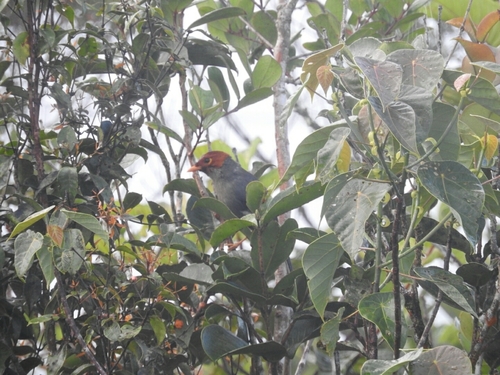
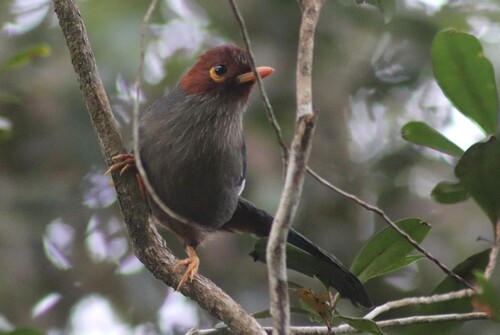
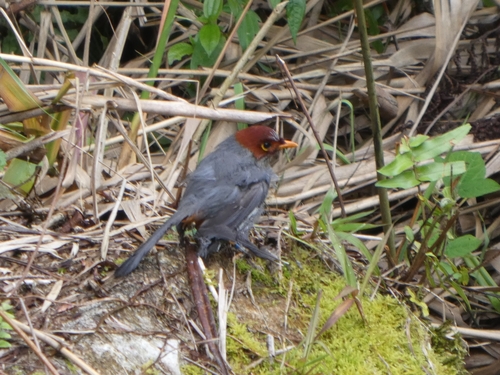
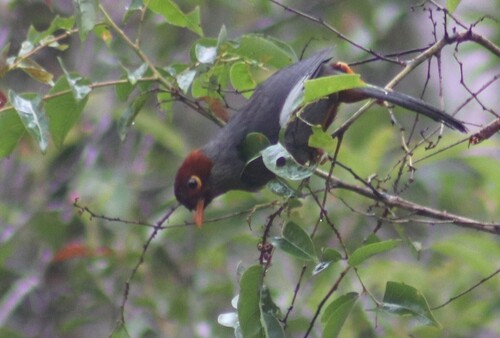
The chestnut-hooded laughingthrush is 22–24 cm (8.7–9.4 in) long, with both sexes having similar appearances. In the nominate subspecies, the chin, lores (area between the eyes and nostrils), supercilium (line above the eye), feathers around the nostrils, and the area around the base of the bill are chestnut brown. The forehead, front of the crown (top of the head), and the area from the eyes down to the chin are darker, with some greyish-white feathering on the crown. The throat, breast, and upper belly are dull yellowish-brown with a greyish tinge and dull yellowish-brown streaking. Voice: The song of the chestnut-hooded laughingthrush is a fluty, high-pitched chu-wu, chwi-wi-wi-wi-wiee-wiu-wu with rather clicky starting notes or a rising and falling wiu-wu-wu-wi-wi-wee-wu. It also makes an even-pitched series of up to 12 wi notes, a wu-tuwu-tuwu, or a ri'-ri'-ri, all of which are punctuated with a to-we-oh to-we-oh.
Text from Wikipedia, licensed CC BY-SA 4.0.
When to see the Chestnut-hooded Laughingthrush
One bar for each month. Filled bars are the 10 months with records; pale bars are months with none. The wide bar is July, the month with the most records.
Where to see the Chestnut-hooded Laughingthrush
The map shades 1 country with regular records. Everything unshaded has no records. Countries are listed below the map.
About the Chestnut-hooded Laughingthrush
The chestnut-hooded laughingthrush is a species of bird in the laughingthrush family Leiothrichidae endemic to Borneo. Described by the British ornithologist Richard Bowdler Sharpe as a distinct species in 1879, it was subsequently considered a subspecies of the chestnut-capped laughingthrush until 2007, when it was again raised to species status by the ornithologists Nigel Collar and Craig Robson. It is 22–24 cm (8.7–9.4 in) long, with a chestnut brown head and chin, with grey feathering on the top of the head. The upperparts and the side of the neck are slaty-grey, with a long white wing patch.
Text adapted from Wikipedia, licensed CC BY-SA 4.0.
Easily confused with
 Rusty LaughingthrushPterorhinus poecilorhynchusThe rusty laughingthrush is a species of bird in the family Leiothrichidae.
 Chestnut-capped LaughingthrushPterorhinus mitratusThe chestnut-capped laughingthrush, also known as the spectacled laughingthrush, is a species of bird in the family Leiothrichidae.
 Rufous-necked LaughingthrushPterorhinus ruficollisThe rufous-necked laughingthrush is actually not a thrush but a species of babbler, it is roughly 22–27 centimetres (8.7–10.6 in) in length and weighs anywhere between 51–73 grams (1.8–2.6 oz).
Side by side: Chestnut-hooded Laughingthrush vs Rufous-necked Laughingthrush
Learn the Chestnut-hooded Laughingthrush in the BeakBrain App
Photo and call practice. Coming soon to iPhone and Android.
Play today's Daily BirdEvery photo and recording on this page is credited to its author under the licence shown. Spotted a problem with this page, or have a better photo? Contribute.